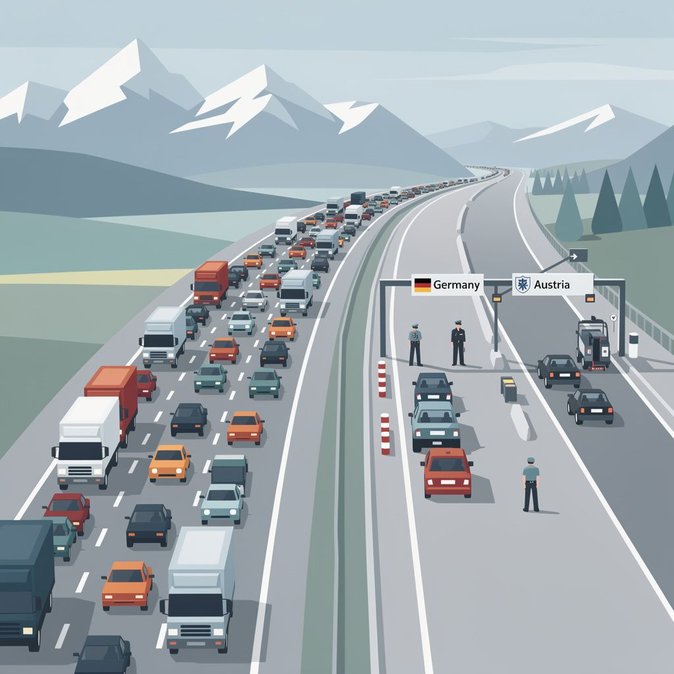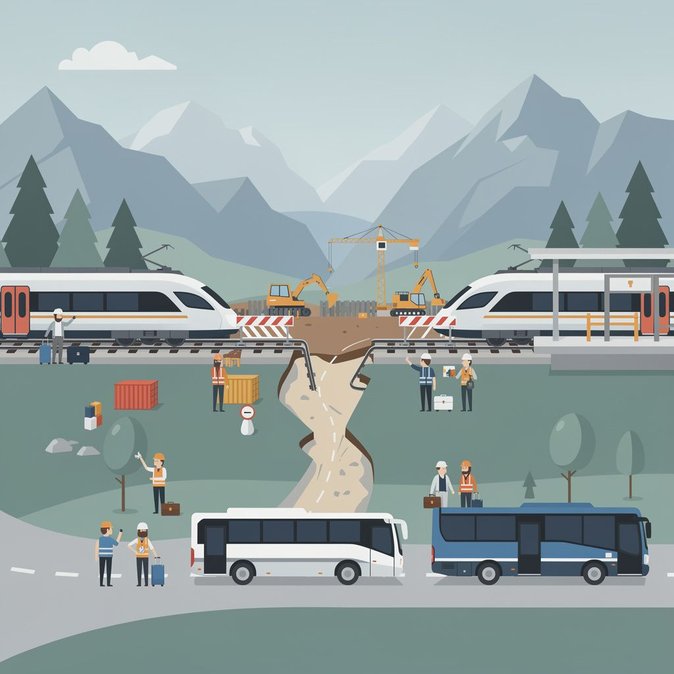
Travellers moving between Austria and Italy via the key Brenner rail corridor faced a full day of disruption on Sunday, 15 November 2026. According to the South Tyrolean transport authority’s real-time bulletin, extensive engineering works around Waidbruck-Lajen forced Railjet (RJ) and EuroCity (EC) long-distance services to run to amended timetables, while some trains—such as the Vienna–Bolzano RJX 186/187 pair—were cancelled outright. Regional services on Line 100 (Brenner – Brixen – Bolzano) were reduced to a two-hourly frequency in both directions. To keep people and freight moving, the operator arranged a dense network of replacement coaches. Between Bolzano and Franzensfeste, buses ran every 30 minutes, dovetailing with an hourly rail shuttle on the Franzensfeste–Brenner sector to preserve cross-border connections. Dedicated boarding bays were sign-posted at each intermediate station—including hot-spots such as Brixen, Klausen and Sterzing—to streamline transfers for passengers with luggage. The Brenner axis is one of Europe’s busiest north–south freight and passenger arteries, linking the ports of Northern Italy with the manufacturing hubs of Southern Germany and Central Europe. Any closure ripples through supply chains and corporate travel programmes, a reminder of the infrastructure bottlenecks that still characterise Alpine mobility while the long-awaited Brenner Base Tunnel inches towards its revised 2032 opening. Business-travel managers with employees transiting between Vienna, Munich and Northern Italy were advised to add at least one hour to itineraries, re-check seat reservations and remind staff that bikes are not permitted on the substitute buses. Forwarders moving time-critical cargo were urged to evaluate road alternatives across the Tauern or via Switzerland, though winter tyres are already mandatory on those routes. While Sunday’s works are scheduled to end before the Monday morning peak, ÖBB and Trenitalia warned that additional overnight windows are likely in early 2027 as part of the multi-year track-renewal programme. Companies with regular cross-border movements should monitor carrier alerts and consider flexible tickets or multimodal routings to mitigate further disruption.