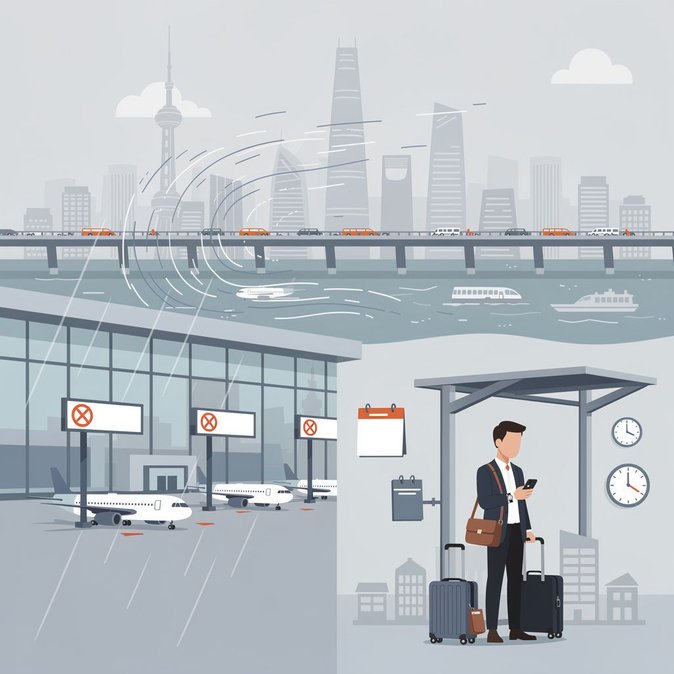
A late-season storm christened Typhoon “White Dolphin” barrelled into the Yangtze River Delta on the morning of 15 November, forcing Shanghai’s two international airports to slash capacity and triggering knock-on disruption across one of Asia’s busiest corporate travel corridors. According to real-time notices from financial newswire GMT EIGHT, 1,384 of the 2,300 scheduled flights at Pudong (PVG) and Hongqiao (SHA) were cancelled, with the remaining services operating under low-visibility, low-wind procedures that lengthened taxi-out times and queueing on arrival. Hangzhou Xiaoshan airport reported a further 270 cancellations as the storm’s outer bands pushed westward. Ground transport fared no better. Shanghai’s metro slowed all above-ground sections to safety crawl speeds, ferry operations across the Huangpu River and to Chongming Island were suspended, and the 36-km Hangzhou Bay Bridge—an artery for container trucks moving between Zhejiang and Jiangsu—closed in both directions. Logistics operators said same-day airfreight cut-off times were brought forward by six hours; express couriers moved urgent consignments to Nanjing Lukou to beat the weather window. For multinationals running East-China manufacturing hubs, contingency plans kicked in. Several electronics assemblers in Suzhou activated split-shift housing to keep expatriate engineers on-site, while law firms advised business travellers holding single-entry visas to monitor validity and file for humanitarian extensions if forced to over-stay. The Shanghai Foreign Affairs Office reminded foreign residents that the city’s 24-hour police registration rule remains in force even during extreme weather; hotels must upload guest data within two hours of check-in. Meteorologists at the China Meteorological Administration expect “White Dolphin” to weaken into a tropical depression by early 16 November, but warn of residual gale-force gusts that could keep flight schedules severely curtailed through Monday evening. Corporates with critical movements are being urged to reroute via Beijing, Qingdao or Wuhan, where spare capacity remains. The episode is a stark reminder that even post-pandemic China travel requires robust business-continuity planning—especially in a typhoon season now stretching well into November.
Source: GMT EIGHT