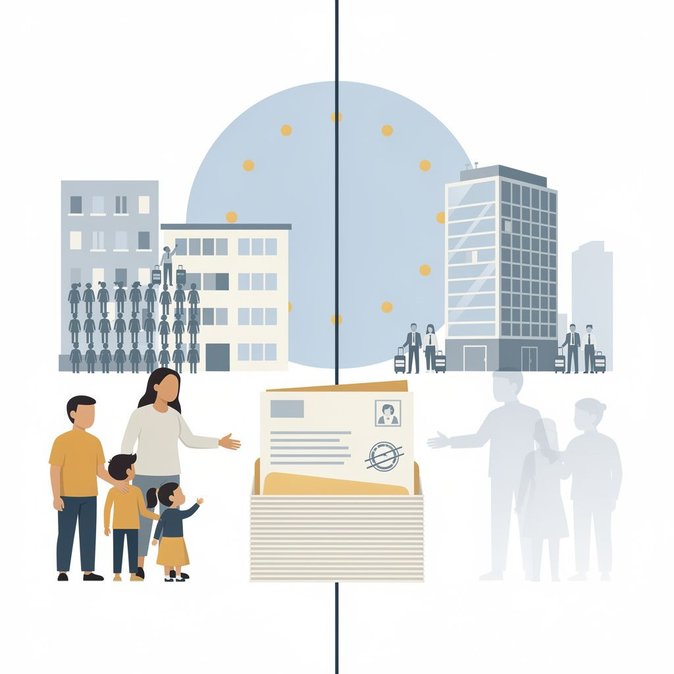
Interior ministers from nine European Union countries – Austria, Bulgaria, Czechia, Finland, Greece, Italy, Luxembourg, the Netherlands and Poland – have sent a joint letter to EU Home-Affairs Commissioner Magnus Brunner asking the Commission to reopen the 2003 Family Reunification Directive. The letter, dispatched late on 13 November and reported by APA and Prague-based Expats.cz on Saturday afternoon, argues that family-reunification arrivals are placing “acute pressure” on schools, housing markets, healthcare systems and municipal budgets across Central and Southern Europe. Although the directive already allows member states to impose waiting periods of up to two years and to require proof of adequate housing and income, the nine governments say those safeguards are insufficient in the current context of multiple displacement crises. They contend that the “pull factor” of generous family-reunification rights complicates national efforts to integrate recognised refugees and beneficiaries of subsidiary protection, particularly in urban districts where classrooms are already overcrowded and social-housing waiting lists are long. Prague’s signature reflects domestic political sensitivities. Since Russia’s full-scale invasion of Ukraine in 2022, Czechia has issued more than 550,000 temporary-protection permits – one of the highest per-capita figures in the EU. Officials warn that secondary movements of relatives could accelerate as the war drags on and as Ukrainian men become eligible for reunion once military restrictions are eased. At the same time, labour-market shortages make the government wary of measures that could discourage economically active migrants. The ministers did not spell out the exact amendments they want, but diplomats say options include lengthening waiting periods, capping the total number of relatives per sponsor, or linking admission to a proven integration record. Any change would require the normal EU legislative process, so businesses and NGOs have time to lobby. Human-rights groups have already called the initiative “collective punishment” of refugees and note that family separation is a major driver of irregular onward travel. For employers relying on international talent, the proposal adds another layer of uncertainty. If Czechia ultimately tightens reunification rules, highly skilled staff could face longer waits before spouses and children may join them. Mobility managers should therefore review relocation timelines, factor in possible legal fees, and prepare to provide enhanced support services should EU-level reform gain traction.
Source: Expats.cz