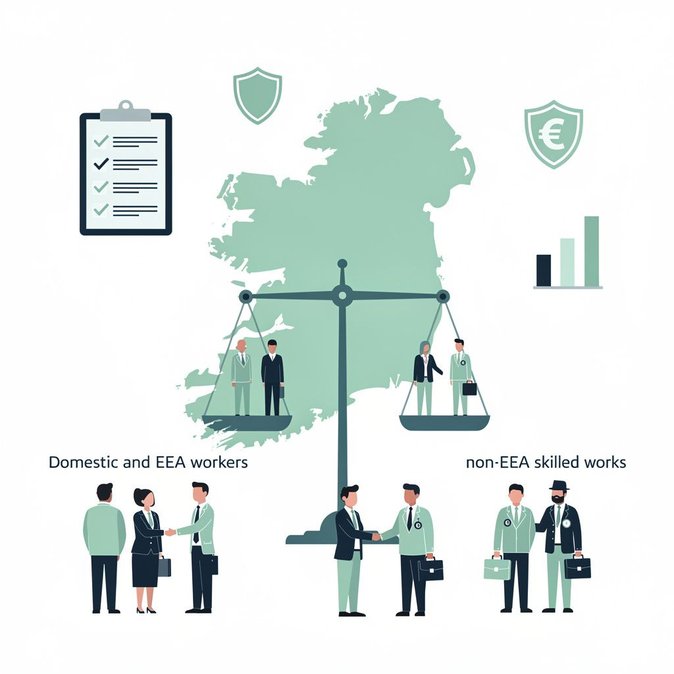
The Department of Enterprise, Trade and Employment has released the General Scheme of the Employment (Miscellaneous Provisions) Bill 2026, launching the next phase of Ireland’s long-planned overhaul of its employment-permit regime. Published on 15 November, the scheme proposes targeted amendments to the Employment Permits Act 2024 with the twin aims of giving employers faster access to critical skills while maintaining labour-market protections for Irish and other EEA workers. A headline change is the review of the so-called “50:50 rule”, which currently requires at least half of a company’s workforce to be EEA nationals before any non-EEA permit can be issued. Ministers argue that rigid ratios no longer reflect demographic reality: Ireland’s working-age population is growing more slowly than demand for talent in ICT, life-sciences and construction. Although the scheme does not set a new quota, officials indicate that more flexible, sector-specific thresholds are under consideration. Businesses should therefore plan for consultation rounds early in 2027 before final numbers are fixed in the draft Bill. Other proposals include streamlined renewal procedures, the ability to issue multi-year permits in sectors with chronic shortages, and a statutory basis for the fast-track Trusted Partner scheme. The Bill would also create explicit powers to suspend or revoke permits where labour-law breaches are proven—addressing EU criticisms that current enforcement is patchy. Digitisation features prominently: the department confirms Phase 2 of the Employment Permits Online portal is now complete and will form the legal default for all new applications once the legislation passes. For employers, the immediate takeaway is that nothing changes overnight. The General Scheme is a blueprint that will now undergo pre-legislative scrutiny by the Oireachtas Enterprise Committee. Nevertheless, HR teams should map workforce plans against the likely removal or softening of the 50:50 rule and prepare evidence for sectoral quotas. Migrant workers considering Ireland can take comfort from the Government’s direction of travel: the policy narrative is clearly shifting from control to competitiveness, provided worker protections remain intact. Observers expect the Bill to be formally introduced in the Dáil during the spring session, with enactment possible by late-2027. Given Ireland’s tight labour market and record inward investment, few doubt that modernising the permit system has become an economic imperative rather than an administrative nicety.
Source: DailyDigest