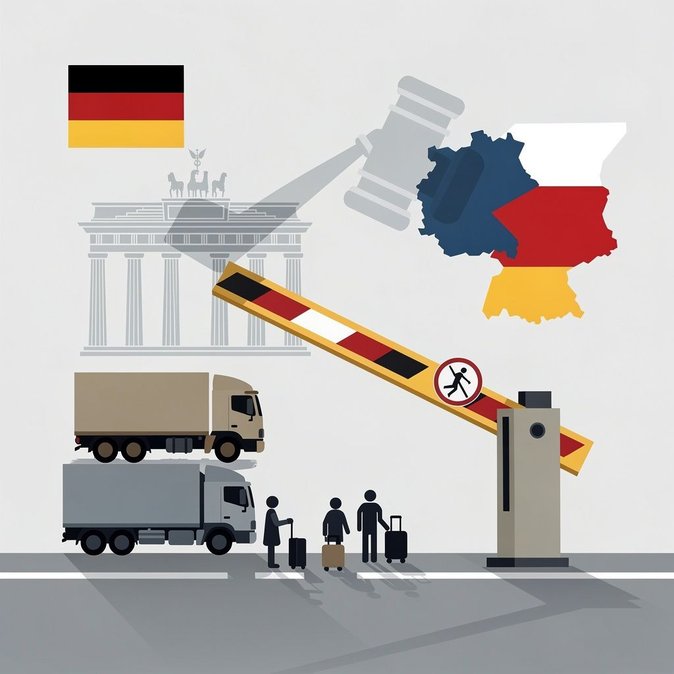
The Administrative Court in Dresden has ruled that spot checks carried out by the German Federal Police at the Polish and Czech borders were incompatible with EU law during the periods examined. The judgement—handed down in two separate cases brought by a Polish driver and a German bus passenger—also found that ministerial orders authorising the controls lacked sufficient justification under the Schengen Borders Code. While the decisions are not yet final and may be appealed to the Saxon Higher Administrative Court, they strike at the legal basis for Germany’s temporary re-introduction of controls first imposed in 2023 and repeatedly prolonged to curb irregular migration. Berlin’s latest notification to the European Commission extends checks on all land frontiers, including those with Poland, until 15 March 2027. For logistics operators and cross-border commuters, the practical impact is immediate but nuanced. The court did not order an end to the current regime, meaning drivers must still plan for document inspections and possible delays. However, the verdict strengthens future claims for damages and increases pressure on the interior ministry to provide more granular risk assessments before any further extensions. Polish businesses have already complained that ad-hoc stops disrupt just-in-time supply chains servicing factories in Saxony and Brandenburg. If higher courts uphold the ruling, Germany may be forced either to tighten the geographical and temporal scope of the checks or to rely on police ‘mobile controls’ that do not require a formal suspension of Schengen free movement. The case also resonates politically in Warsaw, where officials have argued that Poland’s own temporary controls on its western and northern borders are proportionate. A German legal reversal could embolden critics of prolonged internal border measures across the EU.
Source: eTransport.pl