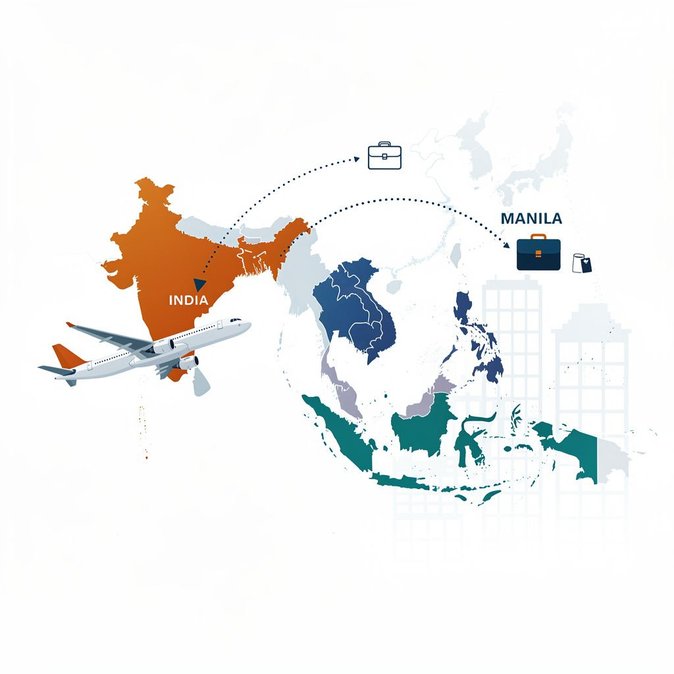
New Delhi’s Act East policy will take a distinctly people-centric turn this week as Prime Minister Narendra Modi lands in Manila for the 23rd ASEAN-India Summit (17 November) and the 21st East Asia Summit. In a departure statement released early on 16 November, Modi called connectivity and “people-to-people relations” the heart of India’s partnership with Southeast Asia. Senior officials travelling with the Prime Minister told reporters that New Delhi will push three mobility deliverables: 1. A draft ASEAN-India Air Services Agreement that could open unlimited third- and fourth-freedom passenger and cargo rights on routes linking Tier-2 Indian cities to secondary Southeast-Asian hubs, helping Indian exporters and business travellers bypass congested metros. 2. A fast-track business-visa scheme that would commit all ten ASEAN states to issue multi-entry visas to accredited Indian executives within five working days—mirroring India’s existing 5-day commitment for ASEAN nationals. 3. Mutual social-security exemptions for short-term assignees, starting with shipping, IT and engineering firms that rotate Indian staff through Singapore, Vietnam and the Philippines. Background: ASEAN already accounts for US$131 billion in two-way trade, and over 12 % of India’s outward FDI. Yet the lack of direct flights beyond Singapore and Bangkok, and uneven visa rules, remain pain-points for Indian companies that rely on short-cycle rotations of engineers, project managers and after-sales teams. Negotiations on an air-services accord have stalled since 2024 over concerns about capacity dumping; Manila, this year’s ASEAN chair, is keen to close at least a “limited fifth-freedom” deal covering key manufacturing corridors. Practical implications: An air-services accord would let carriers like IndiGo and Air India Express launch point-to-point routes from Bengaluru to Cebu or Chennai to Da Nang, cutting travel time by 6–9 hours and lowering logistics costs for electronics, pharma and perishable exports. The proposed fast-track visa lane would, for the first time, give Indian passport-holders a predictable, multi-entry option across the region—critical for project bids that require rapid mobilisation. If agreed, social-security exemptions could save companies up to 18 % of payroll costs on postings under 24 months. Looking ahead: Officials expect leaders to bless the three initiatives in principle on 17 November and task ministers to sign implementing protocols by mid-2027. Corporates should map which employee cohorts could shift from “single-trip” to “multi-entry” travel and identify cost savings from potential social-security waivers.