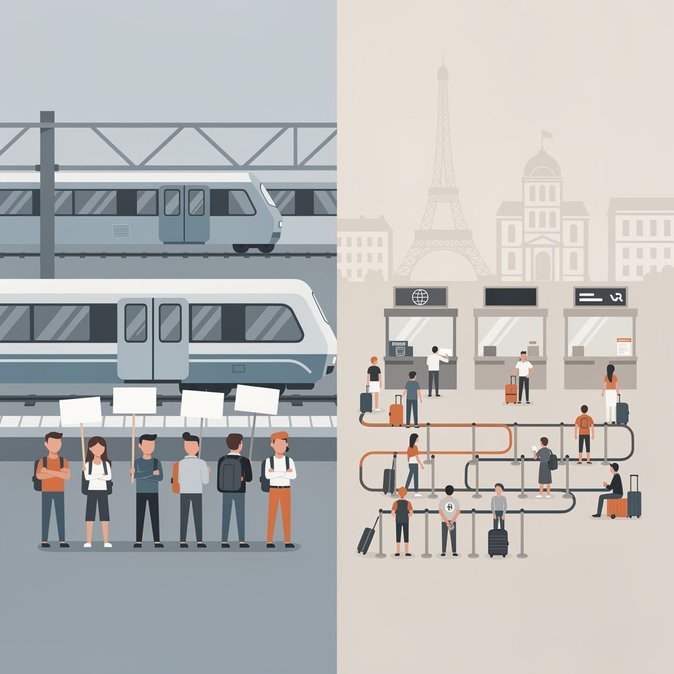
France’s autumn of labour unrest rolled on yesterday, 19 November, as a coalition of public-sector unions and student groups staged a one-day strike and march against elements of the 2027 draft budget. While turnout estimates varied—from 1,000 demonstrators on the streets of Paris to unverified claims of tens of thousands nationwide—the walk-out was enough to snarl urban transport in Lyon, Bordeaux and Marseille and to create longer queues at airport border counters where police unions operated “slow-down” tactics. At Paris-Charles-de-Gaulle (CDG) and Orly airports, travellers reported passport-control waits averaging 40 minutes in the late afternoon, against the 10-minute norm during the same weekday slot. French border-police unions said the action was intended to underline staffing shortages exacerbated by the EU Entry/Exit System (EES), which requires manual biometric enrolment for many third-country arrivals. Rail services on RER suburban lines B and D—critical airport connectors—were reduced by up to a third during peak hours, prompting Air France to issue a rebooking waiver for domestic feeders. In the freight sector, port and road-toll operations were largely unaffected, but logistics associations warned that escalating strike calendars could converge with the newly announced SIVEP walk-outs at northern BCPs, multiplying disruption for importers. Business-traveller risk consultancies have already raised France’s strike-related mobility threat level to “moderate–high” through mid-December, advising companies to build flexible itineraries and to monitor union notices 48 hours before travel. Politically, the protests signal stiff resistance to budget plans that freeze pension indexation for higher-income retirees and modestly raise VAT on non-essential goods. The government must now decide whether to offer concessions before the Senate vote on 5 December or to risk further street action that could coincide with the holiday peak. For corporates running expatriate programmes in France, the key operational takeaway is to brief travelling staff on potential rolling stoppages, particularly in transport hubs, and to secure appointment slots early for immigration formalities that could be delayed by civil-service participation in future strikes.
Source: CrisisBrief