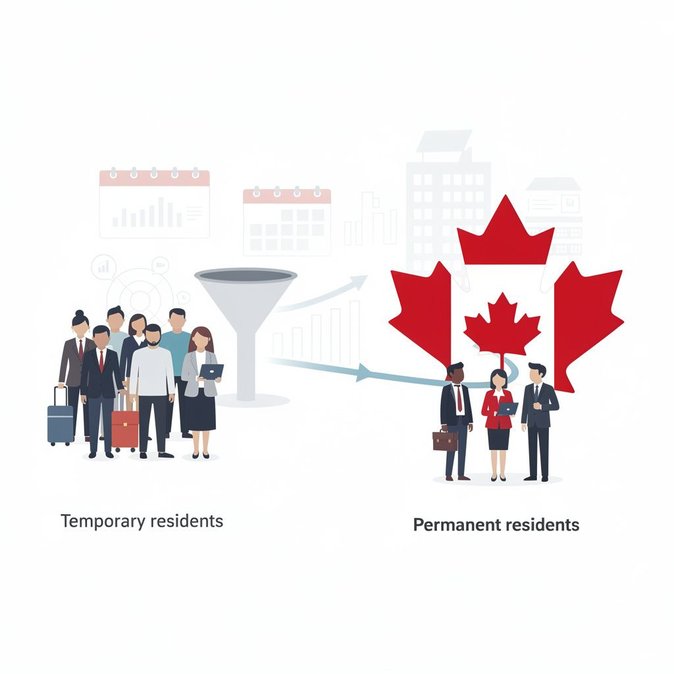
In a detailed backgrounder published late on Friday, November 20, Immigration, Refugees and Citizenship Canada (IRCC) laid out a three-year roadmap that will hold federal immigration targets steady while overhauling how newcomers are selected. The 2027-2029 Immigration Levels Plan caps temporary-resident admissions at 370,000 per year and permanent-resident admissions at 380,000—levels that Ottawa says equal “less than one per cent of Canada’s population” and give housing and public-service capacity time to catch up. Economic programs will continue to dominate, accounting for more than 64 per cent of all permanent-resident spots. The plan’s centre-piece is a new time-limited measure that will convert up to 200,000 people already in Canada—split evenly between a workers cohort and a humanitarian cohort—to permanent residence in 2027. Provinces will receive extra Provincial Nominee Program (PNP) allocations to nominate workers who match regional labour shortages, while Ottawa will clear long-pending humanitarian and family files, including the Hong Kong and Ukraine pathways, to reduce backlogs. IRCC says the measure will keep families together and accelerate processing to a 12-month target for spousal cases. Express Entry reforms, announced earlier this month, underpin the economic strategy. Category-based selection will continue, but a new Labour-Market Integration Factor worth up to 150 points will reward candidates with Canadian work experience in high-wage occupations; job-offer points will rise and no longer require an LMIA. Francophone immigration outside Quebec will increase from 9.5 per cent of admissions in 2027 to 12 per cent in 2029. A permanent Rural Community Immigration Pilot will also launch to help smaller centres retain talent. For employers, the plan offers greater predictability on visa inventory and clarifies that 220,000 new work-permit holders and up to 150,000 international students can still enter annually—figures critical to sectors such as tech, health care and advanced manufacturing. Multinationals running Canadian assignments are advised to align workforce planning with the capped numbers and to monitor forthcoming ministerial instructions that will spell out how the 200,000 transition places are allocated. Immigration lawyers note that stabilising intake is only half the battle; IRCC must also deliver faster processing and a more transparent points system. Businesses, however, broadly welcomed a shift away from ever-higher headline targets toward quality, retention and regional alignment, arguing that predictability is vital for long-term investment decisions.