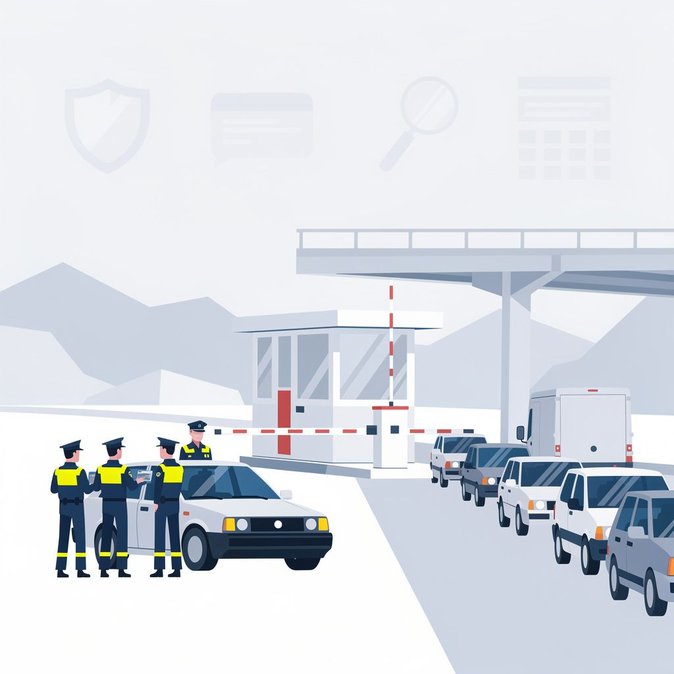
Swiss border security received a high-profile stress test this autumn and the results have just been published. Between September and early November, the Ticino cantonal police and the Federal Office for Customs and Border Security (BAZG/UDSC) mounted 43 joint checkpoints on the secondary roads that lace the Mendrisiotto, the stretch of southern Switzerland that funnels road traffic to and from Italy. On Friday, 20 November, the two agencies released the consolidated figures: 699 travellers and 461 vehicles were stopped for identity, customs and road-safety checks. The three-month operation was explicitly designed to flush out irregular cross-border traffic in the run-up to the end-of-year shopping season, when day-trippers, delivery vans and seasonal workers converge on Ticino. Officers uncovered 43 legal violations: 26 traffic offences under the Federal Road Traffic Act and 17 breaches of the Customs Act. Among the more serious findings were a forged identity document, a vehicle with a purpose-built concealment compartment containing 1.5 grams of cocaine, and three individuals who were already the subject of outstanding arrest warrants. The suspects were handed over to the public prosecutor; the cocaine was confiscated. Although the absolute numbers are modest, the operation offers a snapshot of the compliance pressure companies face when moving staff or goods across Switzerland’s southern border. The Mendrisiotto is a vital artery for the pharmaceutical, fashion and high-tech sectors that maintain distribution hubs on both sides of the frontier. False papers and undeclared goods can lead to entry refusals that derail time-critical business travel or just-in-time supply chains. The police emphasised that such sweeps will be repeated "without prior notice" and urged employers to review drivers’ licences, vehicle documentation and customs declarations before dispatching staff. Mobility managers should also remind internationally hired employees that Switzerland’s penalties for document fraud include up to three years’ imprisonment as well as multi-year bans on re-entry. For cross-border commuters, even minor traffic fines can jeopardise renewal of the frequently used G-permit. Strategically, the exercise underlines Bern’s resolve to couple the Schengen Entry/Exit System with old-fashioned boots-on-the-ground controls. Expect more data-driven “micro-operations” that combine automatic number-plate recognition with random spot checks—particularly in regions, like Ticino, where the economic pull of Switzerland’s labour market meets the EU’s external border.
Source: Corriere del Ticino / RSI