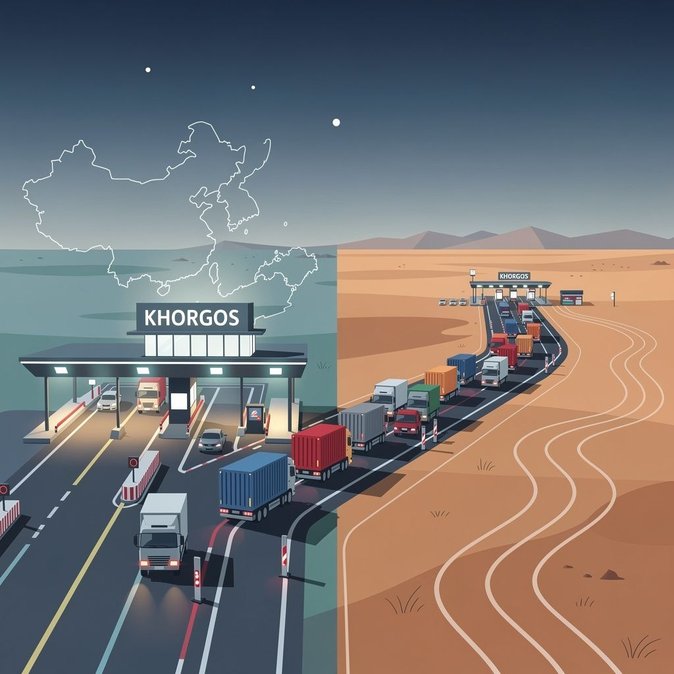
China’s western land gateway of Khorgos is enjoying a boom in overland exports, with Xinjiang customs reporting 46.4 million tonnes of cargo handled in 2025, keeping the port at the top of the province’s rankings for an eighth straight year. A South China Morning Post report published on 21 November highlights how demand from Central Asian markets and Iran has transformed the once-sleepy border town into a logistics powerhouse. The success comes at a cost further down the route. On the same day, Uzbekistan’s Customs Committee issued a statement explaining viral footage of long truck queues at Kazakh border posts. Daily vehicle flows between Uzbekistan and Kazakhstan have surged 2.7-fold since 2021—reaching more than 3,100 trucks—partly because Kazakhstan’s Nur Zholy/Khorgos checkpoint on the Chinese frontier now operates around the clock, accelerating Chinese imports westward. For Chinese exporters and multinational supply-chain managers, the 24-hour service shortens transit times on the New Eurasian Land Bridge, making road and rail an even stronger alternative to congested ocean routes. Electronics assembled in Chengdu can now reach Almaty in under 36 hours, while e-commerce parcels dispatched from Urumqi are arriving in Tashkent two days sooner than a year ago. Yet the downstream congestion underscores the importance of end-to-end visibility. Logistics providers recommend advance slot bookings at secondary Kazakh and Uzbek crossings and advising drivers to carry extra fuel and provisions. Companies moving time-sensitive cargo—or personnel by road—should monitor queue dashboards published by Kazakh customs and consider rail options via Alashankou or the China-Kyrgyzstan-Uzbekistan corridor when delays exceed 12 hours.