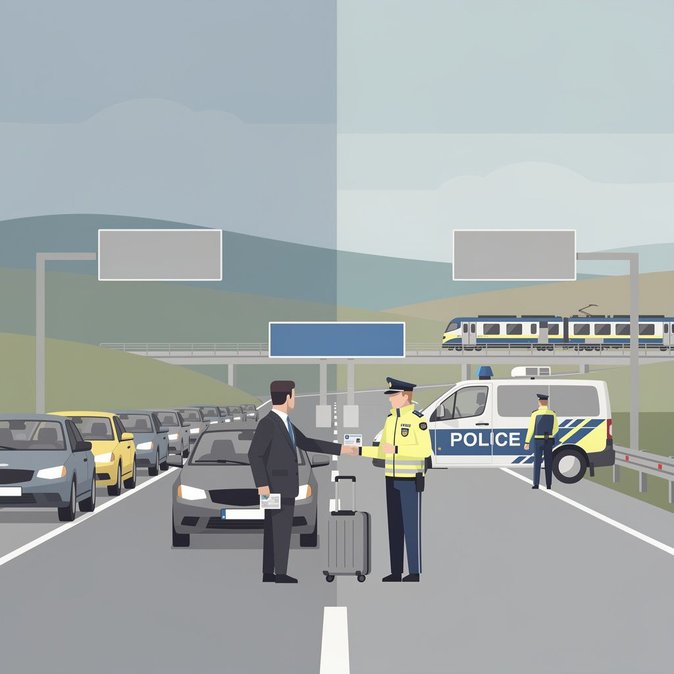
Germany’s Federal Police in Munich have released an extensive performance review of the temporary Schengen-internal border checks in Bavaria. According to the report, officers registered 23,738 unauthorised entries and arrested 1,146 suspected people-smugglers between 16 September 2024 and 31 October 2026. During the same period they executed 5,449 outstanding arrest warrants and intercepted 477 individuals categorised as extremists. The controls, ordered by the Federal Ministry of the Interior in autumn 2024, cover the road and rail crossings to Austria and the Czech Republic and have since been extended to the land borders with France, the Netherlands, Belgium, Luxembourg and Denmark. Berlin argues the measure is necessary to curb secondary movements within the EU and to disrupt increasingly professional smuggling networks operating along the Balkan and Mediterranean corridors. For companies that send employees across the Bavarian frontiers the figures confirm that routine ID checks remain the new normal. Coaches and shuttle vans are stopped regularly on the A3 and A8 motorways, and rail passengers face document inspections on trans-border trains. Employers should therefore continue to advise mobile staff to carry passports or national ID cards, allow extra travel time and budget for potential delays. Politically, the statistics will add fuel to the national debate on the proportionality of prolonged internal border controls. The European Commission has already asked Germany to present an exit strategy, while neighbouring Austria is lobbying for an EU-wide approach that shares the policing burden. The latest numbers suggest that a complete rollback is unlikely before mid-2027 at the earliest.
Source: Polizei.news