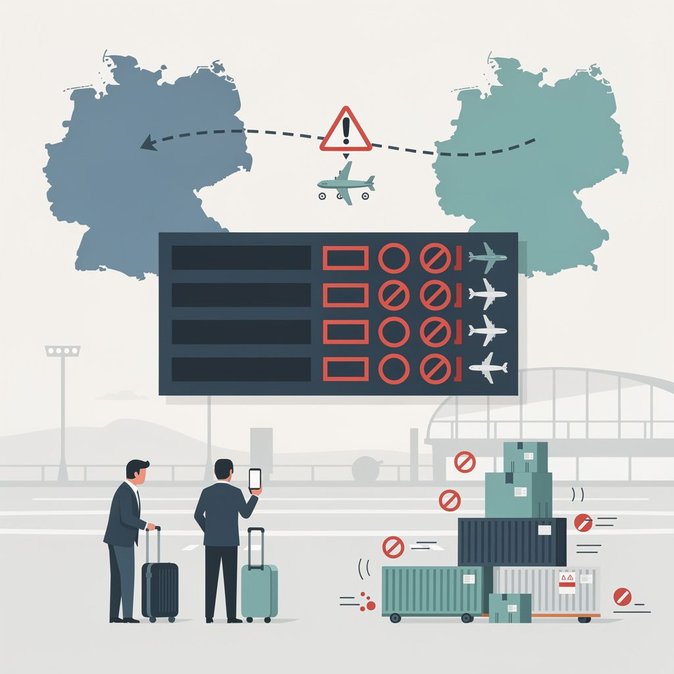
A one-day general strike by Belgium’s main trade-union federations shut down the country’s air-traffic control service (Skeyes) from 07:00 to 21:00 CET on Monday, 23 November 2026. Frankfurt Airport—Germany’s busiest international hub—had to cancel every flight to and from Brussels after Lufthansa and Brussels Airlines were forced to pull the plug on their shared codeshare services. Real-time departure boards in Frankfurt showed at least ten cancellations, including morning services SN/LH 2608 and SN/LH 2607 and the high-demand evening rotation SN/LH 2618/5589. Airlines criticised the last-minute nature of the walk-out, warning that thousands of passengers—many of them corporate travellers connecting via Frankfurt—were stranded or forced to re-route through Amsterdam, Paris or Zurich at short notice. The strike is part of a broader Belgian protest day against federal austerity measures. Although German airspace and ground staff were not directly involved, the knock-on effect highlights the fragility of Europe’s interconnected aviation network: when one country’s air-traffic control goes dark, neighbouring hubs such as Frankfurt take the hit. Cargo operators reported having to truck time-critical consignments from Liège and Brussels to Frankfurt overnight to make long-haul connections. For mobility managers in Germany the incident is a reminder to build contingency plans that include multi-modal routings and same-day rail alternatives (ICE/Thalys) between Germany and the Benelux region. It also underlines the importance of advising travellers to monitor industrial-action calendars in neighbouring states, even when their itineraries begin and end on German soil. Lufthansa said normal operations on the Brussels route should resume on Tuesday, 24 November, but warned of residual delays while aircraft and crews are repositioned.
Source: t-online / dpa