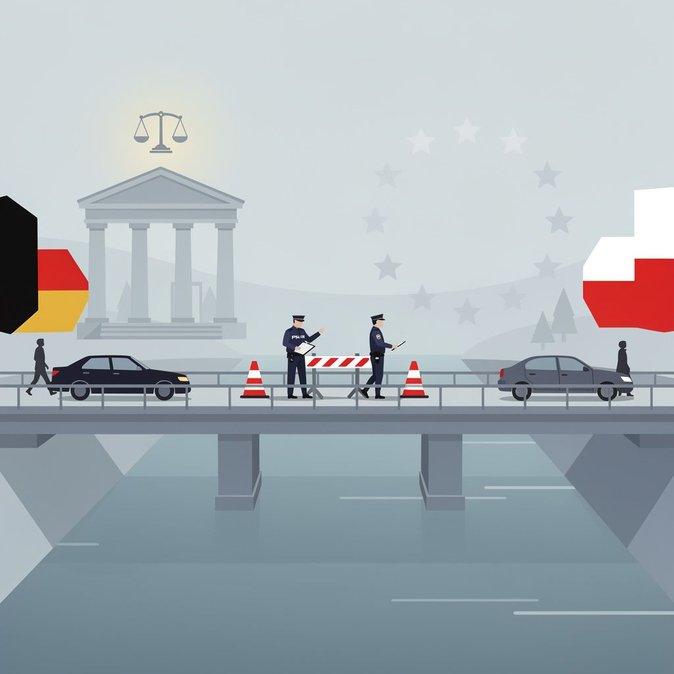
In a decision that could have wider implications for Germany’s controversial re-introduction of Schengen internal border controls, the Administrative Court in Dresden has ruled that a stop-and-search operation carried out by federal police on the city bridge between Zgorzelec (Poland) and Görlitz (Germany) was unlawful. The verdict, reported by Upday on 22 November 2026, concerns the case of 38-year-old dual national Jakub Woliński, who was stopped on 25 September 2024 while driving into Görlitz. The judges found that officers failed to demonstrate the “imminent threat” required under Section 22 of the Federal Police Act to justify identity checks outside fixed checkpoints. Although the ruling applies only to Woliński’s specific case, legal observers say it bolsters arguments that the blanket patrols introduced by Interior Minister Alexander Dobrindt since October 2025 exceed proportionality standards set by the European Court of Justice. Berlin has already announced it will appeal, emphasising that stationary and mobile controls remain necessary to combat people-smuggling networks on the eastern flank of Germany. The ministry insists the wider border-control regime—renewed most recently on 12 November for another six months—is unaffected. For cross-border commuters and logistics operators the symbolic win fuels uncertainty. If higher courts uphold the decision, thousands of similar stops could be challenged, potentially triggering compensation claims and forcing the government to narrow the geographic scope of its checks. Businesses moving goods between Silesia and Saxony would benefit from a lighter regime, but a sudden rollback without a replacement risk-based system could reignite political debate over irregular migration flows. Practical takeaway: while controls continue, travellers should carry valid ID and allow extra transit time. Companies with staff shuttling across the Polish border should brief employees on their rights during spot checks and monitor forthcoming case law, which may redefine police powers in internal Schengen zones.
Source: Upday