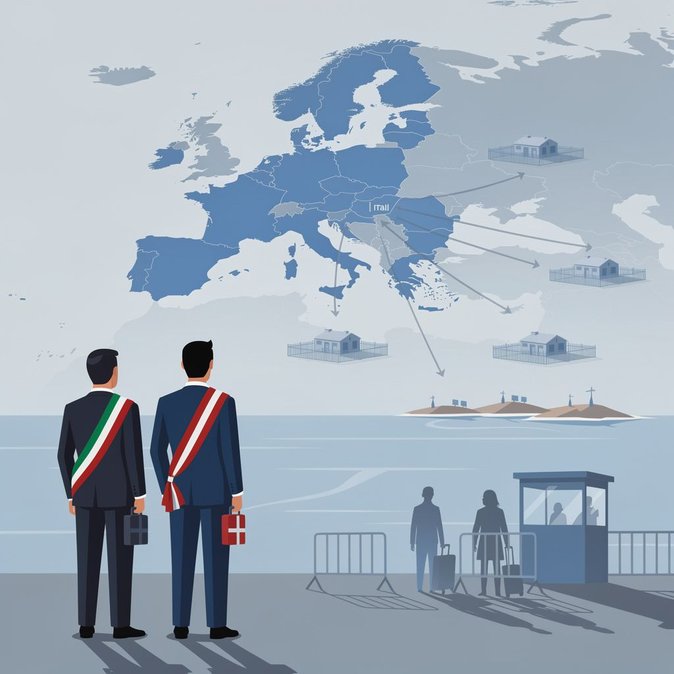
Italian prime minister Giorgia Meloni and Denmark’s social-democrat leader Mette Frederiksen have cemented an unlikely alliance on migration policy on the eve of the 26-27 November extraordinary European Council. In an opinion piece and coordinated social-media posts released on 25 November, the two leaders repeated their call for “more effective returns and offshore processing centres”, arguing that Europe must be able to remove irregular migrants swiftly to protect social cohesion. The partnership bridges two very different political families—Meloni comes from a post-neo-fascist background, Frederiksen from Nordic social democracy—but both have made domestic political gains by adopting tougher asylum stances. Over the last year the pair met three times in Rome and Copenhagen, and co-sponsored the controversial EU plan to finance a “returns hub” in Rwanda as well as Italy’s bilateral accord to process asylum seekers in Albanian centres. Diplomats say the duo will push other heads of government this week to back a “coalition of willing” able to outsource asylum procedures beyond EU borders. For Rome the alliance is strategic: Italy, which has received almost 29,000 irregular arrivals so far this year, hopes a harder European line will relieve pressure on its reception system and reduce secondary movements that damage Schengen. For Copenhagen it consolidates Frederiksen’s pivot rightwards and helps fend off the Danish People’s Party. Critics, including Amnesty International and several centre-left MEPs, warn that externalising asylum risks violating the Geneva Convention and creating legal black holes similar to those criticised in Australia and the UK. Business impact: multinationals moving staff intra-EU should monitor whether proposed offshore centres or faster return procedures end up slowing family-reunification and long-stay visa processing, especially for third-country contractors. Companies employing seasonal labour from outside the EU will want clarity on whether stricter return benchmarks could lead to quota reductions in future Flussi decrees. Travel programmes should likewise track any knock-on effect on Schengen internal-border checks if political compromise at the summit proves elusive.
Source: Le Monde (English edition)