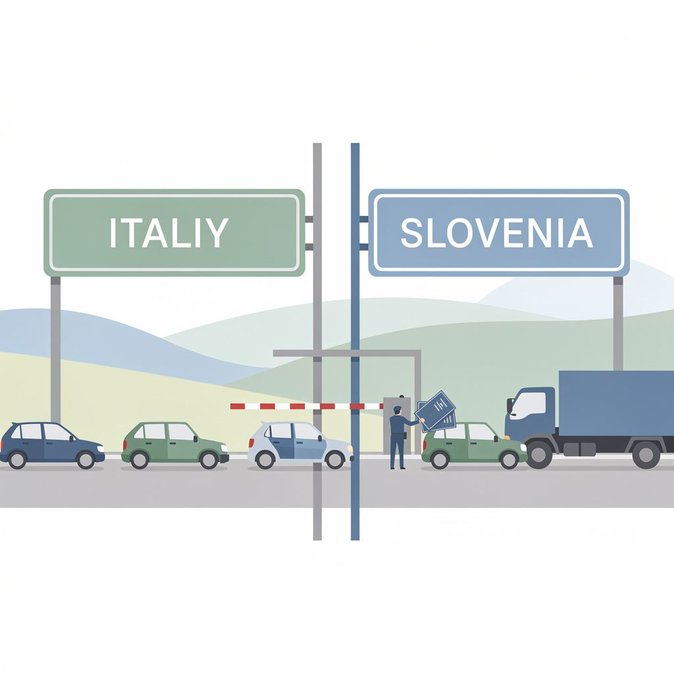
The Italian Interior Ministry has quietly notified the European Commission that it will prolong the temporary re-introduction of Schengen internal border controls on the land frontier with Slovenia for a further six-month period running from 19 December 2026 to 18 June 2027. The notification, published on 23 November on the Commission’s live register of border-control measures, cites the “continued threat of terrorist infiltrations into migratory flows along the Western Balkan route” as well as the persistence of organised smuggling networks operating between the two countries. Italy first reinstated controls on the Slovenian border in October 2023 and has renewed them every six months since, arguing that the measure is necessary to manage irregular migration and safeguard internal security. Under the Schengen Borders Code, internal border controls are meant to be exceptional, proportionate and time-limited. Nevertheless, the Italian government maintains that the security environment in the Western Balkans and the Middle East, coupled with the still-elevated volume of irregular entries through the “Balkan corridor”, justifies a further extension. The Commission has not objected, but Brussels has reminded Rome that detailed risk assessments must accompany each prolongation and that longer-term alternatives—such as reinforced police co-operation and joint patrols—should be pursued. For businesses, the practical impact will be felt most acutely by cross-border commuters, freight operators and corporate travellers who regularly transit the Fernetti, Rabuiese and other busy crossings near Trieste. Drivers should expect identity checks, occasional secondary inspections and sporadic queues, especially during peak holiday traffic in December and at Easter. Logistics providers moving time-sensitive goods between northern Italy and Central Europe should review delivery schedules, factor in potential delays of up to 45 minutes per crossing, and ensure that CMR and customs documentation is readily to hand. Companies that post workers or second staff across the border will need to verify that employees carry either a valid passport or national ID card at all times and have proof of residence or work authorisation in Italy if requested. Multinational employers may also wish to update their duty-of-care briefings to highlight the renewed controls and the possibility of ad-hoc searches of company vehicles. Travellers with tight onward connections from Trieste Airport or who plan to continue by train to Venice or Milan should allow extra buffer time. While the extension is scheduled to expire on 18 June 2027, the pattern of rolling six-month renewals suggests that controls could remain in place for the foreseeable future unless migration pressures ease significantly. Businesses with operations on both sides of the border are therefore advised to incorporate the checkpoint into longer-term mobility planning and to monitor subsequent Commission publications for any early indication of further extensions or a return to friction-free Schengen travel.