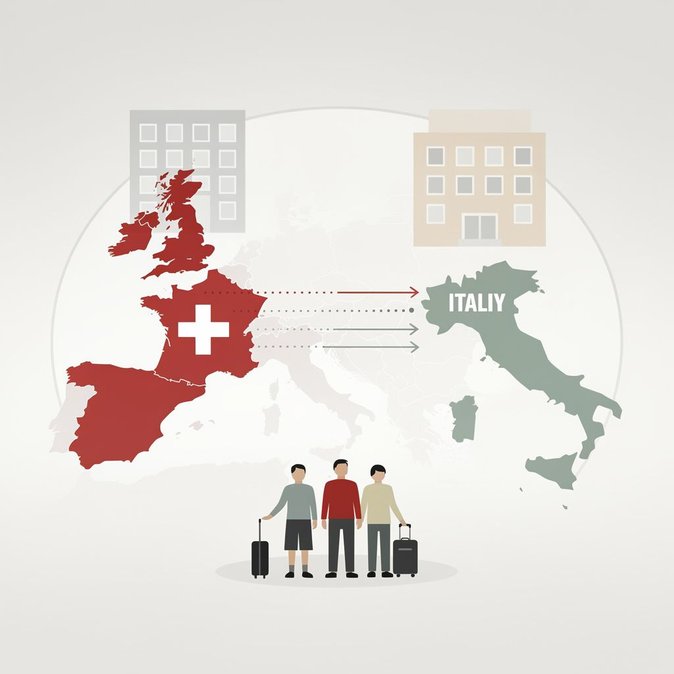
For the first time in more than three years, Switzerland has succeeded in completing individual ‘Dublin’ returns of asylum-seekers to Italy. According to the State Secretariat for Migration (SEM), a "small number" of adult male applicants whose asylum responsibility lies with Rome were transferred this week from Swiss federal centres to Italian authorities at the Chiasso–Ponte Chiasso border crossing. The move follows months of diplomatic pressure after Italy unilaterally stopped accepting returns in late 2022, citing capacity constraints in its reception system. Under the EU-wide Dublin III Regulation – which also binds Switzerland, Norway, Iceland and Liechtenstein – the state where a migrant first enters the Schengen area is normally responsible for processing the asylum claim. When transfers collapsed, Switzerland was forced to examine hundreds of cases for which it was not formally competent. SEM figures show around 773 dossiers are still theoretically returnable to Italy, but Swiss officials stress that the recent hand-overs represent a cautious pilot rather than a blanket resumption. Families, women and minors are currently excluded while reception conditions in Italy are monitored. For Swiss business and cantonal authorities the restart matters because prolonged procedural limbo clogs accommodation capacity, raises administrative costs and heightens political pressure for tougher domestic asylum rules. Cantons have warned that without functioning Dublin cooperation they risk shortages in reception places needed for employees on intracompany transfers and for seasonal workers who must be housed upon arrival. Restoring predictable cross-border returns is therefore seen as a prerequisite for maintaining Switzerland’s comparatively liberal labour migration regime. Human-rights organisations remain wary. The Swiss Refugee Council (SFH) insisted that each case be examined individually to ensure access to shelter, healthcare and a full asylum procedure in Italy. The NGO plans an on-site mission in spring 2027 to track returnees’ situations. SEM, for its part, says it will expand transfers only if Italy continues to accept them without last-minute cancellations – something Justice Minister Beat Jans had complained about as recently as September. Practically, companies moving staff across European offices should assume that ordinary Schengen travel between Switzerland and Italy remains visa-free, but transferees whose family members lodge asylum requests could again face relocation to Italy. Mobility managers are advised to check whether dependants’ first Eurozone entry point was Italian territory and to prepare for possible cross-border interviews. If the pilot holds, experts expect SEM to push for a gradual return to pre-2022 transfer volumes over the course of 2027, easing pressure on Swiss reception infrastructure and helping preserve political support for the free-movement pillars of Bilaterals I and III.
Source: JournalPlus