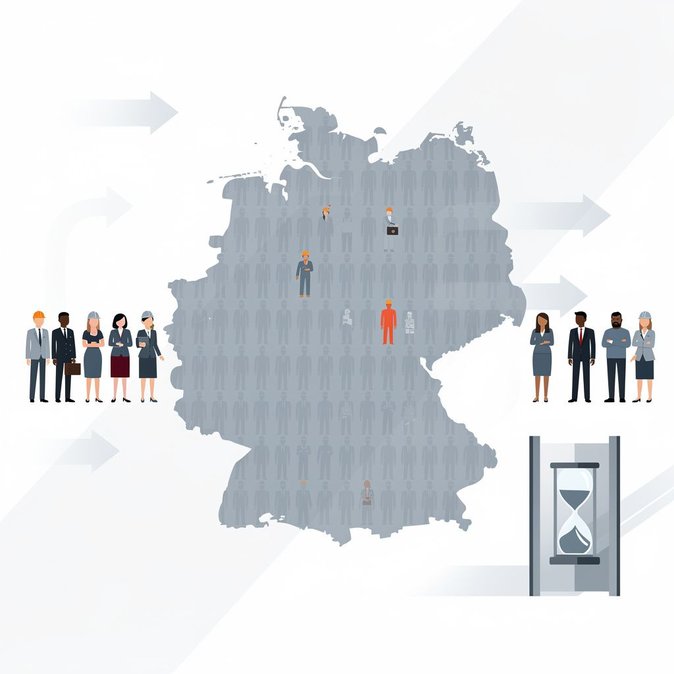
A feature published by industry outlet AKTIV highlights new forecasts from the Cologne Institute for Economic Research (IW) showing that Germany will face a shortfall of 720,000 skilled workers as early as 2029 and up to 4.3 million by 2036 unless immigration from non-EU countries accelerates. The report notes that traditional source countries such as Poland, Bulgaria and Romania have largely exhausted available talent, while demographic ageing will see 13.3 million Germans retire by 2040. Employer federation president Rainer Dulger calls Germany’s current visa process “a bureaucratic obstacle course,” pressing the government to revive momentum on the stalled Work-and-Stay Agency. The article underscores sectors most at risk—vehicle electronics, mechatronics, care and early-childhood education—and praises government migration partnerships with India, Morocco and Uzbekistan. It also cites data that one-third of foreign graduates from German universities stay permanently, making streamlined student-to-work pathways a priority. For multinational HR teams, the findings reinforce the need to broaden recruitment beyond the EU, invest in German-language upskilling overseas, and secure Blue Cards before quotas tighten. Companies are also advised to monitor salary-threshold changes under the revised Skilled Immigration Act, which from 2026 sets the EU Blue Card floor at €45,934.20. The debate is fueling calls in the Bundestag for a special visa track for mid-career technicians, modelled on Canada’s Express Entry, that could be piloted in late 2027 if legislative time allows.
Source: AKTIV-online