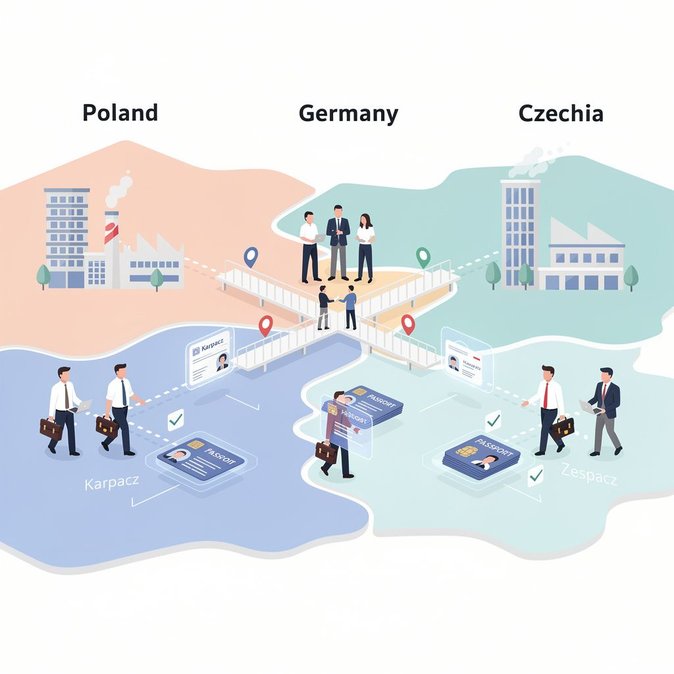
Karpacz – Business delegations from Poland, Germany and the Czech Republic met on 27 November for the 33rd Polish-German-Czech Cooperation Forum, a day-long summit and B2B matchmaking event organised by the Karkonosze Development Regional Agency and Enterprise Europe Network. Held at the Gołębiewski Hotel, the forum attracted over 300 companies from e-mobility, plastics, logistics and IT, all keen to capitalise on the “Tri-Border” region’s role in European supply chains. Panels focused on how differing work-permit regimes and posted-worker rules affect project timelines. Speakers from Lower Silesia’s marshal office called for a trilateral fast-track permit for technicians who shuttle daily across the frontier to service automotive plants. German participants highlighted forthcoming German-language requirements for care-sector visas, while Czech firms pushed for harmonised VAT rules on short-term cross-border services. In practical terms, the forum offered pre-booked 20-minute matchmaking slots. Organisers provided simultaneous translation and an electronic participant catalogue to streamline follow-up—a boon for SMEs without large mobility teams. Several companies signed letters of intent to share warehouse space on the Polish side, citing Poland’s lower energy costs and recently extended border-check regime with Germany as a reason to keep goods within Schengen yet close to the frontier. For HR and global-mobility managers, the key takeaway is momentum toward a pilot ‘service corridor’ that would let engineers cross borders with digital credentials instead of physical A1 certificates. Regional authorities pledged to send a joint proposal to national ministries by February 2027. If adopted, the model could become a template for other EU micro-regions seeking friction-less labour mobility under the forthcoming EU Single Permit revision. The next forum will be hosted by Liberec, Czechia, in May 2027, with organisers promising a progress report on those mobility initiatives.
Source: Enterprise Europe Network