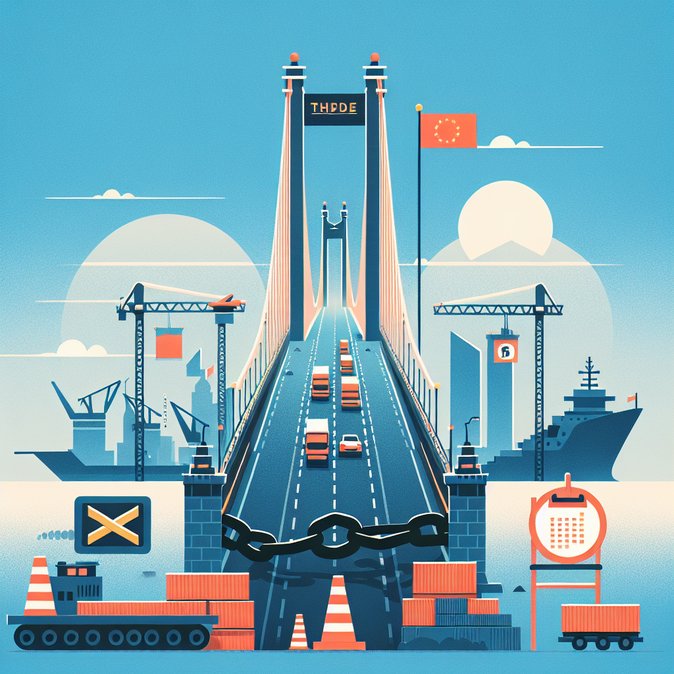
Former U.S. president Donald Trump injected new uncertainty into North American supply-chain planning on February 10 by threatening to deny federal approvals for the Gordie Howe International Bridge, a US$4.8-billion, six-lane span that is 85 % complete and scheduled to open in early 2026. Speaking at a campaign rally in Michigan, Trump demanded that Ottawa cede at least 50 % ownership of the crossing and use U.S.-made steel for remaining construction, or face an executive order preventing the project from entering service.
The Gordie Howe bridge is 100 % financed by Canada; toll revenues are intended to repay construction costs over 50 years. Once operational, it will more than double commercial-truck capacity between Windsor and Detroit—the busiest trade corridor on the continent—reducing bottlenecks that cost manufacturers an estimated C$2.6 billion annually. Canadian officials declined to comment directly on the ultimatum, but Michigan Governor Gretchen Whitmer and the binational Windsor-Detroit Bridge Authority affirmed that construction and testing will proceed on schedule, citing binding inter-governmental agreements.
![Trump threatens to block opening of Canada-funded Gordie Howe International Bridge]()
For mobility managers, the political risk is non-trivial. Auto-sector supply chains rely on just-in-time shipments that cross the existing Ambassador Bridge up to 8,000 times a day. A delayed opening would prolong exposure to single-point-of-failure risk highlighted during the February 2022 border blockade protests, when parts shortages forced temporary shutdowns at Ontario assembly plants. Companies should revisit contingency routes through Sarnia-Port Huron and the Peace Bridge, and monitor U.S. regulatory filings for any signs of a permit challenge.
The broader business implication is the possibility of renewed trade friction as the 2026 mandatory review of the USMCA approaches. Trump’s comments were paired with threats of new aluminum and steel tariffs—moves that could again complicate NAFTA-era rules-of-origin calculations for firms moving personnel and goods across the border. Global-mobility teams should brief executives on potential disruptions to cross-border travel and consider updating B-1/B-2 and TN visa playbooks in case of retaliatory policy shifts.
While most analysts view the threat as political posturing, it introduces a new variable into infrastructure planning and underscores the need for scenario modelling around border throughput and customs staffing levels. The Canada Border Services Agency (CBSA) has already begun hiring 300 additional officers to staff the Gordie Howe crossing; a prolonged delay could see those resources redeployed, impacting wait-times elsewhere.
The Gordie Howe bridge is 100 % financed by Canada; toll revenues are intended to repay construction costs over 50 years. Once operational, it will more than double commercial-truck capacity between Windsor and Detroit—the busiest trade corridor on the continent—reducing bottlenecks that cost manufacturers an estimated C$2.6 billion annually. Canadian officials declined to comment directly on the ultimatum, but Michigan Governor Gretchen Whitmer and the binational Windsor-Detroit Bridge Authority affirmed that construction and testing will proceed on schedule, citing binding inter-governmental agreements.

For mobility managers, the political risk is non-trivial. Auto-sector supply chains rely on just-in-time shipments that cross the existing Ambassador Bridge up to 8,000 times a day. A delayed opening would prolong exposure to single-point-of-failure risk highlighted during the February 2022 border blockade protests, when parts shortages forced temporary shutdowns at Ontario assembly plants. Companies should revisit contingency routes through Sarnia-Port Huron and the Peace Bridge, and monitor U.S. regulatory filings for any signs of a permit challenge.
The broader business implication is the possibility of renewed trade friction as the 2026 mandatory review of the USMCA approaches. Trump’s comments were paired with threats of new aluminum and steel tariffs—moves that could again complicate NAFTA-era rules-of-origin calculations for firms moving personnel and goods across the border. Global-mobility teams should brief executives on potential disruptions to cross-border travel and consider updating B-1/B-2 and TN visa playbooks in case of retaliatory policy shifts.
While most analysts view the threat as political posturing, it introduces a new variable into infrastructure planning and underscores the need for scenario modelling around border throughput and customs staffing levels. The Canada Border Services Agency (CBSA) has already begun hiring 300 additional officers to staff the Gordie Howe crossing; a prolonged delay could see those resources redeployed, impacting wait-times elsewhere.
Source: Associated Press