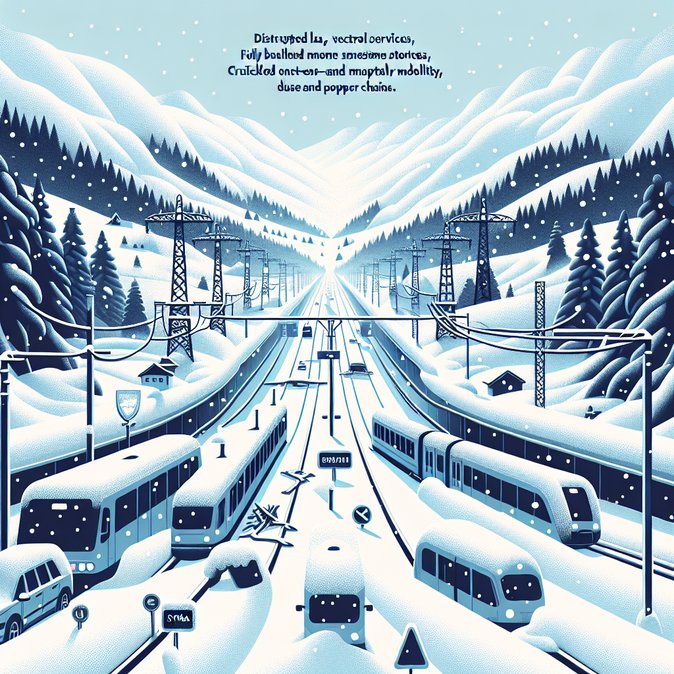
Blizzard conditions blanketed almost the entire country on 20 February, prompting authorities to close major arteries such as the A21 Vienna Outer-Ring Motorway and sections of the S16 Arlberg expressway. Local media reported dozens of jack-knifed lorries and at least one fatal accident involving a snowplough worker in Linz. ÖBB reduced service on the high-speed Weststrecke to single-track operation near Tullnerfeld, while regional trains in Styria and Carinthia were cancelled outright after overhead lines iced over. Power cuts hit 30 000 households, complicating station operations and ticketing systems. The Transport Ministry activated its crisis cell, coordinating 13 000 firefighters and road-maintenance staff. Logistics firms DHL Freight and Gebrüder Weiss switched time-critical consignments to rail-road combined transport via Germany, illustrating the ripple effect on supply chains. Experts described the event as a “1-in-20-year” snowfall for eastern Austria. With climate models predicting more volatile precipitation, infrastructure planners may need to rethink avalanche sheds and emergency power at key tunnels. For global mobility teams, the lesson is clear: domestic last-mile links can become the weakest point in relocation schedules, especially for assignees heading to alpine plants and data centres.
Source: VOL.AT