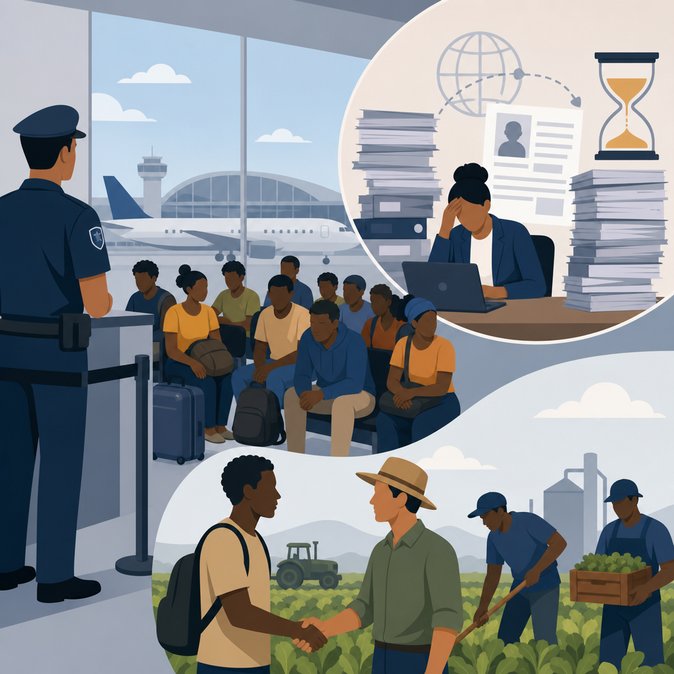
A feature by Unicamp’s Journal on 14 May 2026 shines a spotlight on renewed Haitian migration to Brazil and the bureaucratic barriers confronting arrivals. In March, 120 Haitian nationals were held for more than two days in a restricted area of Viracopos International Airport, Campinas, after landing with incomplete documents; many eventually applied for humanitarian visas but faced lengthy processing and scant translation support. The article follows Guerby Saintè, a Haitian PhD candidate at Unicamp, who acted as interpreter during the incident and later helped create the Association for Social and Cultural Integration (AISC). The volunteer-run group now offers free Portuguese classes, documentation clinics and Federal Police liaisons for over 30 newcomers each month. Researchers argue that such civil-society initiatives fill a gap left by Brazil’s slow humanitarian-visa pipeline. Official figures quoted from Itamaraty show 9,575 visas (humanitarian and family-reunification) issued to Haitians in the first quarter of 2026—insufficient, critics say, given Haiti’s deepening political and security crisis. Anthropologist Omar Ribeiro Thomaz contends that Brazil’s policy “announces humanitarian assistance but imposes almost insurmountable obstacles,” including stringent proof-of-means requirements and delays in diploma recognition that prevent skilled migrants from working. Business-mobility implications are indirect but real: many multinational agribusiness and construction firms rely on Haitian labour in Brazil’s North and Midwest. Delayed regularisation complicates payroll compliance, health-and-safety onboarding and inter-state mobility for these workers. Companies are therefore urged to partner with NGOs and legal clinics to expedite CPF registration and work-permit conversions. The Unicamp piece calls on the federal government to streamline biometric enrolment, expand French- and Creole-language resources at airports, and revisit the humanitarian-visa quota. Absent reforms, observers warn of a growing backlog that could push migrants toward irregular crossings at the Peru and Bolivia borders.
Source: Jornal da Unicamp