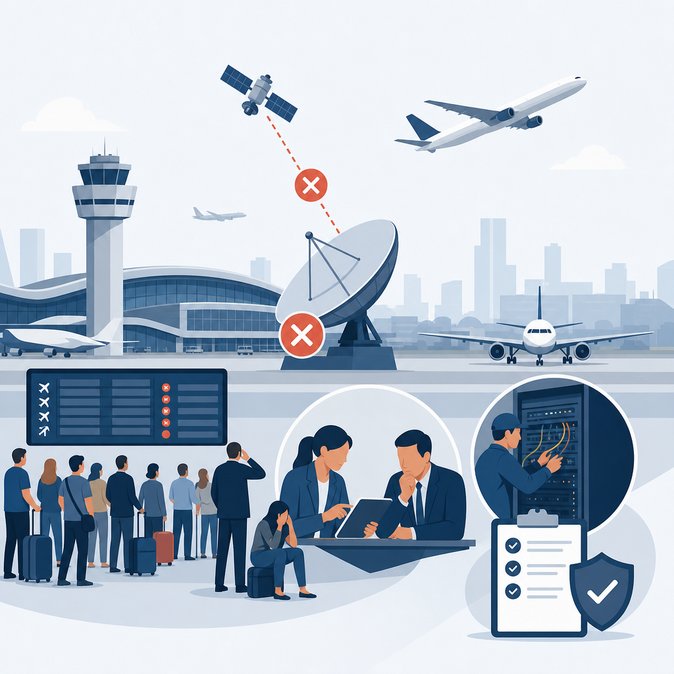
Business travellers awoke to an unexpected backlog on Tuesday morning (2 June) after a failure in Embratel’s satellite-based voice-communication network cut links between air-traffic controllers and pilots serving Brazil’s busiest air corridor. According to the Brazilian Air Force’s Department of Airspace Control (DECEA), the outage began at 09:24 and forced an immediate suspension of take-offs and a metered rate of landings at Congonhas (CGH), Guarulhos (GRU) and Viracopos (VCP). Operations were normalised at 10:40, but by then 35 flights had been cancelled and more than 120 delayed, with knock-on effects rippling across Brasília, Rio de Janeiro and several Latin-American hubs. DECEA said the root cause was “a technical failure in an external communications provider”; Embratel later confirmed a malfunction in one of its geostationary satellites’ ground gateways. Although no safety incident was reported, aircraft already airborne were instructed to hold or divert and ground stops were issued for all departures. The National Civil Aviation Agency (ANAC) has opened a technical review with DECEA and Embratel to determine whether redundant circuits met international ICAO requirements. For corporate mobility managers the disruption is a reminder that South-America’s most important business city still relies on ageing communications infrastructure. Multi-national firms with just-in-time supply chains through GRU’s cargo terminal reported missed connections for high-value parts and pharmaceuticals. Travellers connecting onward to Miami, Frankfurt and Santiago were rebooked on later flights, but hotel bills and duty-of-care costs mounted quickly. Practical take-aways: companies should ensure traveller profiles include updated mobile numbers to receive airline re-accommodation alerts; consider booking critical staff on early-morning departures out of RioGaleão or Brasília when São Paulo weather or infrastructure risks rise; and review travel-insurance policies for coverage of “airport service interruption”. ANAC has already hinted it may strengthen contingency-plan obligations for telecom providers—an issue mobility teams will want to monitor as Brazil prepares for a record influx of visitors during the 2027 Women’s World Cup.
Source: UOL / Agência Estado