Brazilian health authorities have moved quickly to reinforce the country’s disease-control perimeter after the World Health Organization classified the Ebola outbreak in the Democratic Republic of the Congo and Uganda as a Public Health Emergency of International Concern (PHEIC). On Tuesday, 2 June, the National Health Surveillance Agency (Anvisa) published Instruction Normative (IN) 448/2026, updating the temporary health measures that must be observed in all Brazilian ports and international airports. Although officials emphasise that the risk of Ebola being imported is low, the revision keeps the system on high alert and aligns national procedures with the latest WHO and Pan-American Health Organization guidance.
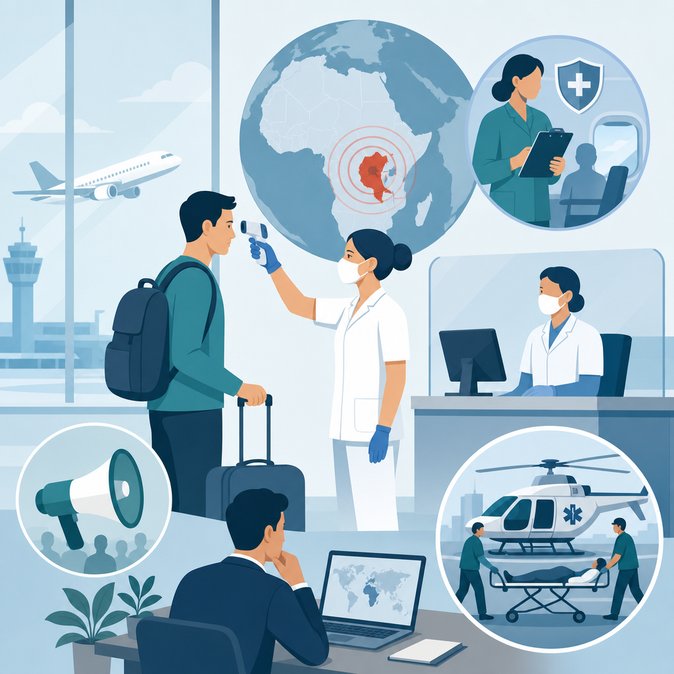
Under the new rule, airports with scheduled international arrivals must install highly visible banners in arrival halls explaining Ebola symptoms, incubation periods and the need to seek immediate medical attention if travellers feel unwell. Airline operators have also been instructed to refresh in-flight announcements on measles and to maintain reporting channels for ill passengers on board.
No quarantine or entry bans are planned, a stance designed to avoid the trade and travel disruptions that characterised the COVID-19 era while still giving border officials legal authority to escalate screening should the regional situation deteriorate. For global mobility and corporate travel teams, the most practical takeaway is that employees arriving from Africa may encounter additional visual screening and questioning—particularly if their itinerary included a connection in Central or East Africa. Mobility managers should review duty-of-care protocols to ensure travellers know how to self-report symptoms and update trip-approval workflows so that medical briefings are provided before departure.
Should travellers or mobility teams need clarity on visa validity, vaccination certificates, or the latest entry requirements published by Anvisa, VisaHQ can streamline the process. Its Brazil portal (https://www.visahq.com/brazil/) consolidates real-time government advisories, application forms and courier services, helping companies and individuals secure the right paperwork quickly while staying compliant with evolving health safeguards.
Brazilian companies operating in the Congo basin or with project sites in neighbouring countries should also revisit medical-evacuation insurance and confirm which Brazilian reference hospitals are authorised to handle a suspected Ebola case. Anvisa’s notice keeps Brazil’s broader list of diseases under enhanced surveillance—currently Ebola, measles and poliomyelitis—unchanged. The agency confirmed that Brazil still fulfils the International Health Regulations core-capacity requirements and that its yellow-fever vaccination certificates and digital International Certificate of Vaccination (CIVP) platform remain valid for cross-border verification. In practical terms, travellers will not face new paperwork, but companies may wish to remind assignees and dependents that existing vaccination and health-declaration rules will be enforced more strictly at points of entry.
Looking ahead, travel and relocation stakeholders should monitor subsequent Anvisa communiqués. IN 448/2026 empowers the health authority to introduce temperature checks, visual triage or mandatory health-declaration cards at very short notice if the epidemiological picture worsens. Given Brazil’s role as a hub for flights connecting Africa and South America, proactive communication with travellers—and contingency planning for potential lay-over delays—will be vital over the coming weeks.
Under the new rule, airports with scheduled international arrivals must install highly visible banners in arrival halls explaining Ebola symptoms, incubation periods and the need to seek immediate medical attention if travellers feel unwell. Airline operators have also been instructed to refresh in-flight announcements on measles and to maintain reporting channels for ill passengers on board.
No quarantine or entry bans are planned, a stance designed to avoid the trade and travel disruptions that characterised the COVID-19 era while still giving border officials legal authority to escalate screening should the regional situation deteriorate. For global mobility and corporate travel teams, the most practical takeaway is that employees arriving from Africa may encounter additional visual screening and questioning—particularly if their itinerary included a connection in Central or East Africa. Mobility managers should review duty-of-care protocols to ensure travellers know how to self-report symptoms and update trip-approval workflows so that medical briefings are provided before departure.
Should travellers or mobility teams need clarity on visa validity, vaccination certificates, or the latest entry requirements published by Anvisa, VisaHQ can streamline the process. Its Brazil portal (https://www.visahq.com/brazil/) consolidates real-time government advisories, application forms and courier services, helping companies and individuals secure the right paperwork quickly while staying compliant with evolving health safeguards.
Brazilian companies operating in the Congo basin or with project sites in neighbouring countries should also revisit medical-evacuation insurance and confirm which Brazilian reference hospitals are authorised to handle a suspected Ebola case. Anvisa’s notice keeps Brazil’s broader list of diseases under enhanced surveillance—currently Ebola, measles and poliomyelitis—unchanged. The agency confirmed that Brazil still fulfils the International Health Regulations core-capacity requirements and that its yellow-fever vaccination certificates and digital International Certificate of Vaccination (CIVP) platform remain valid for cross-border verification. In practical terms, travellers will not face new paperwork, but companies may wish to remind assignees and dependents that existing vaccination and health-declaration rules will be enforced more strictly at points of entry.
Looking ahead, travel and relocation stakeholders should monitor subsequent Anvisa communiqués. IN 448/2026 empowers the health authority to introduce temperature checks, visual triage or mandatory health-declaration cards at very short notice if the epidemiological picture worsens. Given Brazil’s role as a hub for flights connecting Africa and South America, proactive communication with travellers—and contingency planning for potential lay-over delays—will be vital over the coming weeks.