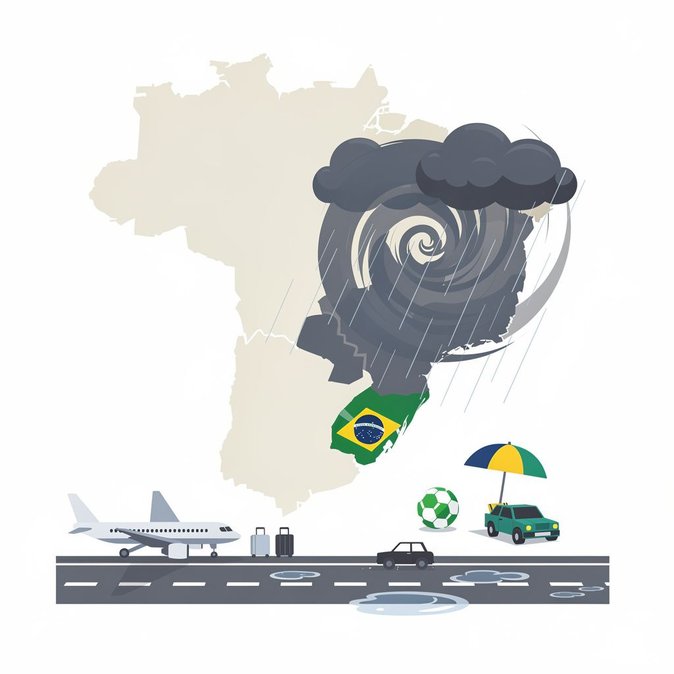
Brazil’s meteorological service Climatempo and SBT News warned on 12 June that an intense low-pressure system will spawn an extratropical cyclone off the southern coast between Friday night and the morning of Saturday 13 June. Heavy rain, wind gusts of up to 70 km/h and localised flooding are forecast for Rio Grande do Sul, Santa Catarina, Paraná and parts of São Paulo and Minas Gerais. Airlines have issued travel advisories for Porto Alegre, Florianópolis and Curitiba, urging passengers to opt for free rebooking or arrive early as wind-shear protocols may slow operations.
While monitoring flight changes, organisations should also keep travel documentation up to date. VisaHQ’s Brazil platform (https://www.visahq.com/brazil/) can expedite visa applications or renewals, provide live status tracking and deliver expert support—valuable advantages when itineraries shift at the last minute due to weather or other disruptions.
Highway authorities in the Serra Gaúcha and Vale do Paraíba regions prepared detours in case of landslides, a recurrent problem when winter fronts collide with saturated soils. For global-mobility teams coordinating expatriate or project travel, the timing is awkward: the bad weather coincides with Valentine’s Day and the first weekend of the World Cup, both peak domestic-travel periods. Companies should review duty-of-care plans, ensure travellers receive push alerts and consider virtual alternatives for Monday meetings if staff cannot return on time. The storm underscores a broader pattern: Brazil’s winter cyclones have become more frequent, and infrastructure resilience is uneven across regions. Business-continuity specialists recommend mapping secondary airports such as Navegantes or Caxias do Sul that can serve as backups when coastal hubs close.
While monitoring flight changes, organisations should also keep travel documentation up to date. VisaHQ’s Brazil platform (https://www.visahq.com/brazil/) can expedite visa applications or renewals, provide live status tracking and deliver expert support—valuable advantages when itineraries shift at the last minute due to weather or other disruptions.
Highway authorities in the Serra Gaúcha and Vale do Paraíba regions prepared detours in case of landslides, a recurrent problem when winter fronts collide with saturated soils. For global-mobility teams coordinating expatriate or project travel, the timing is awkward: the bad weather coincides with Valentine’s Day and the first weekend of the World Cup, both peak domestic-travel periods. Companies should review duty-of-care plans, ensure travellers receive push alerts and consider virtual alternatives for Monday meetings if staff cannot return on time. The storm underscores a broader pattern: Brazil’s winter cyclones have become more frequent, and infrastructure resilience is uneven across regions. Business-continuity specialists recommend mapping secondary airports such as Navegantes or Caxias do Sul that can serve as backups when coastal hubs close.