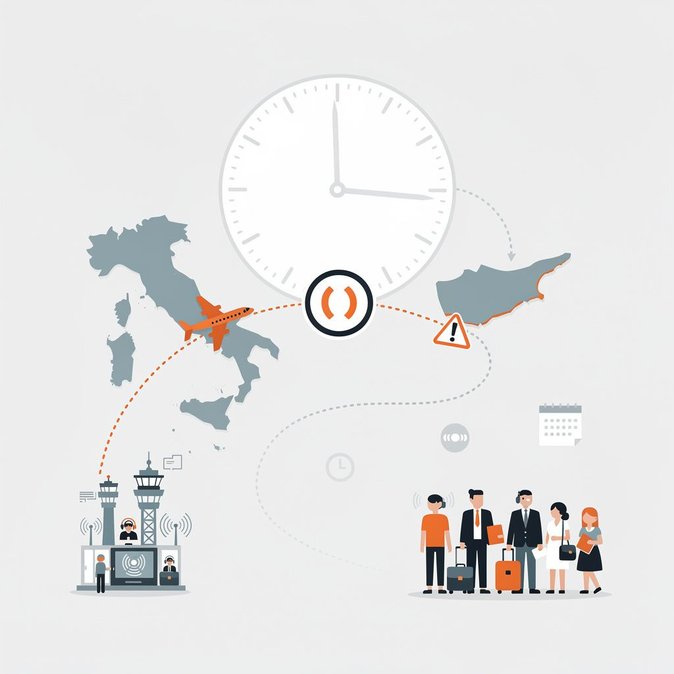
Cypriot travellers felt the knock-on effects of Saturday’s 18-hour aviation strike in Italy, which saw easyJet flight-crew unions and Verona air-traffic-control staff stop work from 06:00 to 24:00. Although Cyprus was not directly involved in the industrial action, easyJet operates multiple weekend rotations linking Larnaca with Milan Malpensa, Venice and Verona, while Verona controllers handle overflights bound for the island. Several morning departures from Italian airports to Larnaca left hours late, forcing aircraft and crews to arrive in Cyprus behind schedule and triggering a ripple of subsequent delays on evening departures back to Italy and the UK.
For travellers suddenly rerouted via unfamiliar hubs, visa or transit-document requirements can become an unwelcome surprise. VisaHQ’s Cyprus portal (https://www.visahq.com/cyprus/) enables individuals and corporate mobility teams to verify at a glance whether a Schengen, transit, or third-country visa is needed for last-minute itinerary changes, and its experts can rush electronic authorisations or courier passports so that industrial-action detours don’t become paperwork nightmares.
Passengers booked on easyJet’s Sunday services reported re-routing or overnight accommodation offers. Cyprus-based tour operators said around 620 package-holiday customers were affected, mainly Germans and Britons connecting via Milan. Under EU Regulation 261/2004, airlines may avoid compensation when delay is caused by ‘extraordinary circumstances’ such as ATC strikes, yet they must still provide meals and – where necessary – hotel rooms. Corporate travel managers should advise employees to keep receipts and screenshots of airline messages; these can support reimbursement claims even when statutory compensation is not payable. The disruption underscores the vulnerability of Cyprus’s connectivity to industrial action abroad. With limited spare capacity at the height of the summer season, a single day’s schedule shock can cascade for 48 hours. Companies with time-sensitive movements – for example fly-in engineers for the energy sector – are urged to build contingency buffers or consider alternative routings via Athens or Tel Aviv when major European labour disputes are announced. According to Italy’s transport-strike calendar, further nationwide walk-outs are pencilled in for 26 July and 8 September. HR and global-mobility teams should track these dates closely and brief mobile employees accordingly.
For travellers suddenly rerouted via unfamiliar hubs, visa or transit-document requirements can become an unwelcome surprise. VisaHQ’s Cyprus portal (https://www.visahq.com/cyprus/) enables individuals and corporate mobility teams to verify at a glance whether a Schengen, transit, or third-country visa is needed for last-minute itinerary changes, and its experts can rush electronic authorisations or courier passports so that industrial-action detours don’t become paperwork nightmares.
Passengers booked on easyJet’s Sunday services reported re-routing or overnight accommodation offers. Cyprus-based tour operators said around 620 package-holiday customers were affected, mainly Germans and Britons connecting via Milan. Under EU Regulation 261/2004, airlines may avoid compensation when delay is caused by ‘extraordinary circumstances’ such as ATC strikes, yet they must still provide meals and – where necessary – hotel rooms. Corporate travel managers should advise employees to keep receipts and screenshots of airline messages; these can support reimbursement claims even when statutory compensation is not payable. The disruption underscores the vulnerability of Cyprus’s connectivity to industrial action abroad. With limited spare capacity at the height of the summer season, a single day’s schedule shock can cascade for 48 hours. Companies with time-sensitive movements – for example fly-in engineers for the energy sector – are urged to build contingency buffers or consider alternative routings via Athens or Tel Aviv when major European labour disputes are announced. According to Italy’s transport-strike calendar, further nationwide walk-outs are pencilled in for 26 July and 8 September. HR and global-mobility teams should track these dates closely and brief mobile employees accordingly.