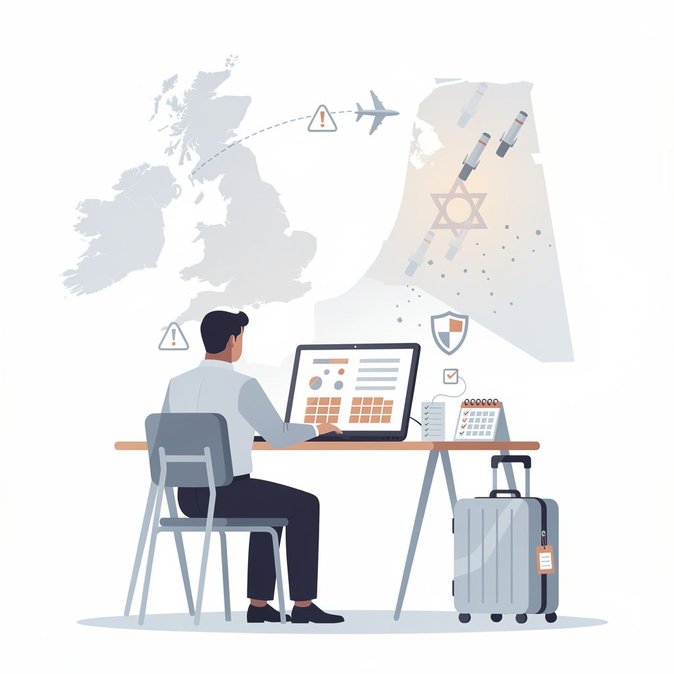
The Foreign, Commonwealth & Development Office (FCDO) on 14 June re-issued its travel advice for Israel and the Occupied Palestinian Territories, maintaining the highest warning levels for Gaza and parts of the West Bank but adding new language on the risk of falling debris from recent Iranian missile exchanges. The notice comes after multiple projectiles were intercepted over central Israel earlier in the week. British nationals are now urged to familiarise themselves with Israel’s Home Front Command alerts and to prepare ‘shelter-in-place’ options.
If travel is unavoidable, British nationals can simplify visa and documentation logistics through VisaHQ. The service provides real-time guidance on entry permits, passports and onward-travel visas, and its UK portal (https://www.visahq.com/united-kingdom/) lets individuals or companies manage multiple applications in one dashboard—especially useful when itineraries change at short notice due to evolving security conditions.
The FCDO reminds travellers that most standard insurance policies become void if they ignore official advice against travel, and that indirect flight routes may be disrupted without notice because of regional air-space closures. For UK companies with staff rotations or project work in Israel, the update will trigger renewed duty-of-care assessments. Travel managers should verify that employees have access to secure accommodation, crisis-communication channels and contingency evacuation plans. Organisations operating ‘fly-in-fly-out’ rotation models must monitor airline schedule volatility and ensure that alternative hubs (for example, Larnaca or Amman) remain viable. From an immigration perspective, delayed exits could affect UK visa overstays or right-to-work timelines for Israeli specialists seconded to Britain. HR teams may need to liaise with the Home Office for flexibility if employees are stranded abroad. While no new legal restrictions were introduced, the sharpened wording underscores how geopolitical flashpoints can upend global mobility at short notice – reinforcing the need for real-time risk tracking.
If travel is unavoidable, British nationals can simplify visa and documentation logistics through VisaHQ. The service provides real-time guidance on entry permits, passports and onward-travel visas, and its UK portal (https://www.visahq.com/united-kingdom/) lets individuals or companies manage multiple applications in one dashboard—especially useful when itineraries change at short notice due to evolving security conditions.
The FCDO reminds travellers that most standard insurance policies become void if they ignore official advice against travel, and that indirect flight routes may be disrupted without notice because of regional air-space closures. For UK companies with staff rotations or project work in Israel, the update will trigger renewed duty-of-care assessments. Travel managers should verify that employees have access to secure accommodation, crisis-communication channels and contingency evacuation plans. Organisations operating ‘fly-in-fly-out’ rotation models must monitor airline schedule volatility and ensure that alternative hubs (for example, Larnaca or Amman) remain viable. From an immigration perspective, delayed exits could affect UK visa overstays or right-to-work timelines for Israeli specialists seconded to Britain. HR teams may need to liaise with the Home Office for flexibility if employees are stranded abroad. While no new legal restrictions were introduced, the sharpened wording underscores how geopolitical flashpoints can upend global mobility at short notice – reinforcing the need for real-time risk tracking.