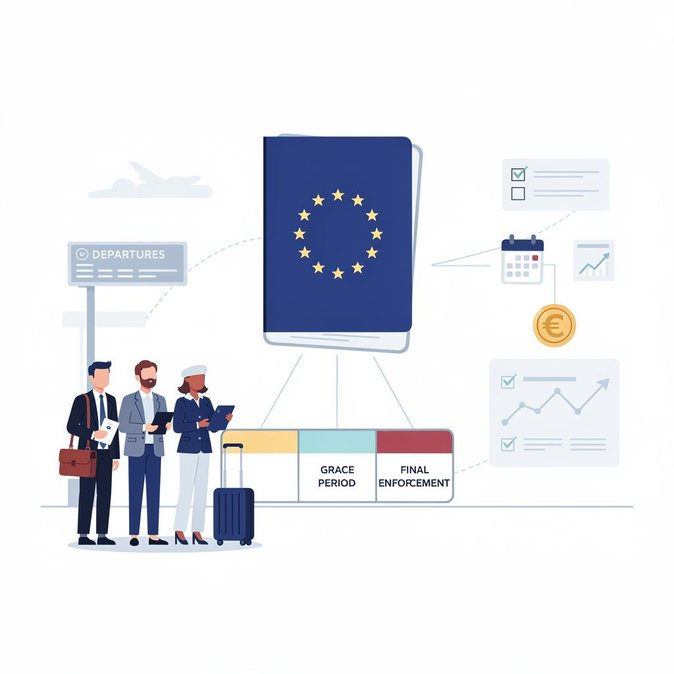
With just months to go before the European Travel Information and Authorisation System (ETIAS) comes online, many British companies have been bracing themselves for an overnight hurdle to continental travel. However, the European Commission’s final implementation plan – analysed in depth by ETIAS Pro on 13 June 2026 – shows the roll-out will be far softer than most corporate mobility teams expected. Under the plan, ETIAS will launch in the last quarter of 2026, but for the first six months the authorisation will be ‘strongly recommended’ rather than compulsory. Airlines will be encouraged – not required – to check passengers have an ETIAS, and border officers may still admit short-stay visitors who arrive without one provided all other entry conditions are met. A further six-month “grace period” will follow in which an ETIAS is mandatory, yet one-time leniency can be granted to travellers arriving for the first time since the transition ended. Only after both stages – most likely in April 2027 – will the authorisation become an absolute requirement. For British businesses the phased approach is a welcome breathing space. Companies that had feared blanket travel bans for staff caught without paperwork now have a full year to build ETIAS checks into booking tools, traveller apps and HR workflows. The staggered model also gives HR teams time to brief mobile staff on the three-year validity of an ETIAS and on the link between expired passports and invalid authorisations. Nevertheless, experts caution against complacency. “Treat the transition as a soft-launch, not a free pass,” says Helen Wade, mobility lead at consultancy TripSphere. “Travellers who miss the recommended window will start trips under a cloud of uncertainty, and carriers that refuse boarding will be within their rights once the grace period begins.” Wade urges firms to budget for the €20 fee (about £17) and to store ETIAS validity dates alongside passport information in their mobility management systems. Practical take-aways for UK organisations include training travel bookers, building an ETIAS prompt into online booking tools, and flagging the need for authorisation renewals when passports are replaced. With the countdown officially under way, corporate mobility teams have time – but not time to waste.
Source: ETIAS Pro