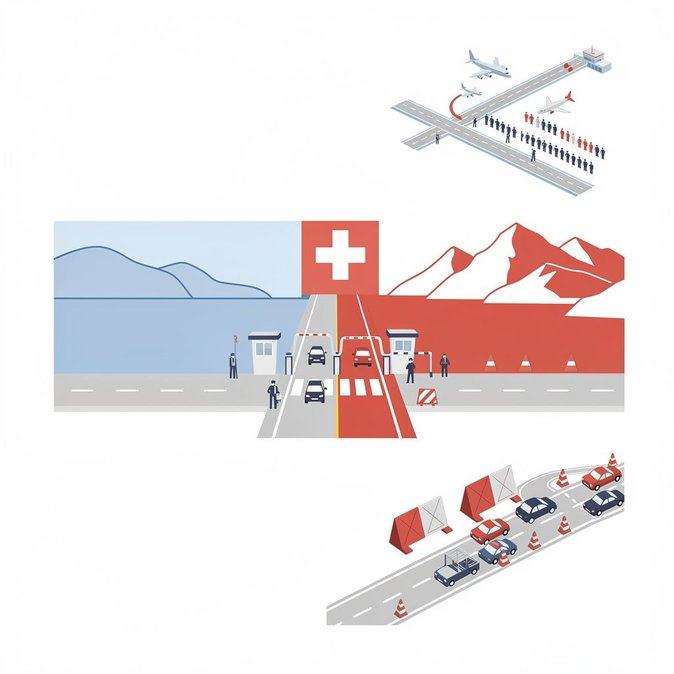
Swiss voters delivered a clear message on Sunday, 14 June 2026, rejecting by 54.8 % the far-right “No to a 10-Million Switzerland” (Sustainability Initiative) that sought to write an absolute demographic ceiling into the constitution. Had it passed, the text would have forced the Federal Council to take whatever measures were necessary—including cancelling the Agreement on the Free Movement of Persons with the EU—to keep the permanent-resident population below 10 million until 2050. The initiative was championed by the Swiss People’s Party (SVP), which argued that rapid population growth driven by immigration is straining housing, transport infrastructure and social services. Business leaders, cantonal governments and the Federal Council warned that arbitrarily capping headcount would cripple sectors from pharmaceuticals to precision engineering that depend on foreign specialists and cross-border commuters. Switzerland currently counts 9 million residents, of whom roughly one in four is a foreign national; more than 350,000 EU citizens commute daily from neighbouring countries. Economists emphasised that labour shortages are already acute. The pharmaceutical cluster around Basel, for instance, recruits 45 % of its workforce from Germany and France; Zurich’s tech start-ups rely on data-science graduates from across Europe. A population cap would have triggered a legal showdown with Brussels, jeopardising a web of bilateral accords that grant Swiss companies tariff-free access to the EU single market and allow seamless business travel. Sunday’s result calms those fears. Free movement remains intact, and the vote underscores the Swiss electorate’s pragmatic streak: voters have repeatedly rejected drastic anti-immigration curbs when the economic stakes were spelled out. Yet the underlying concerns about housing costs, public transport crowding and environmental impact are unlikely to disappear. The Federal Council signalled it will expand ‘sustainability corridors’ in spatial planning, accelerate the construction of high-density housing near rail hubs and invest CHF 2 billion in zero-emission public-transport fleets to ensure that demographic growth remains manageable. For global-mobility managers the message is two-fold: Switzerland’s open-door policy for EU talent and business travellers is secure for now, but pressure to demonstrate the economic value of expatriate assignments will intensify. Companies are advised to engage early with cantonal authorities on workforce-planning needs and to communicate how foreign specialists contribute to Switzerland’s innovation ecosystem.
Source: SWI swissinfo.ch