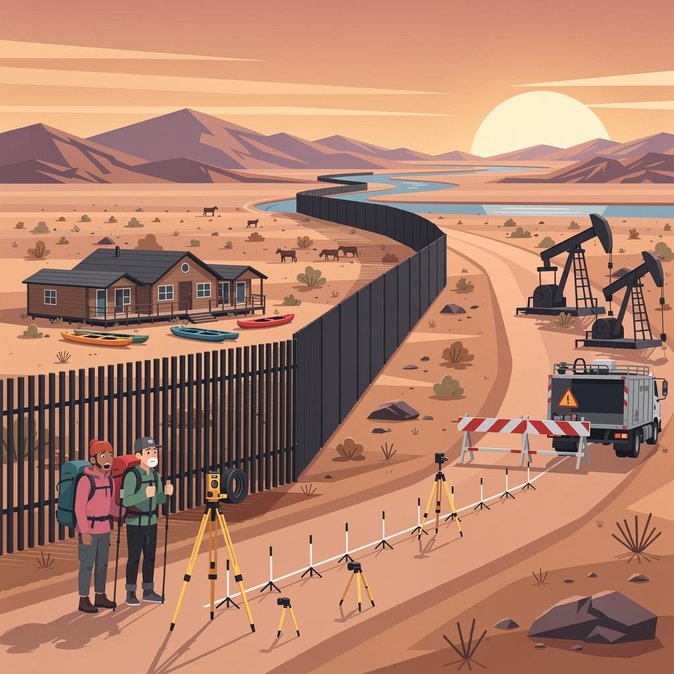
Residents and business owners in West Texas’s remote Big Bend region awoke this month to government letters warning that their properties could be condemned for border-wall construction. A Texas Tribune investigation published Monday details how hundreds of ranchers, farmers and eco-tourism entrepreneurs have been asked to grant survey access—or risk eminent-domain lawsuits from CBP. Although Big Bend accounts for barely 1 percent of total migrant encounters, the Trump administration has earmarked billions of dollars for new security infrastructure in the area, including sections of steel bollard wall, all-weather roads and surveillance towers. Critics argue that seizing private ranchland—some held by the same families since the 1800s—would devastate the regional outdoor-tourism economy that thrives on unobstructed river views and dark-sky preserves. Corporate mobility teams with assignees in the oil-and-gas and renewable-energy sectors are monitoring the developments closely. Several energy majors operate worker housing and logistics hubs in Presidio and Brewster Counties; a physical wall could complicate cross-border supply chains that rely on existing informal river crossings for equipment.
![Land-Seizure Letters for Big Bend Border Wall Stir Business and Property Fears]()
For companies whose operations depend on seamless cross-border movement of personnel and contractors, VisaHQ can help. Their online portal (https://www.visahq.com/united-states/) simplifies U.S. visa and passport applications, provides real-time status updates, and delivers expert compliance guidance—support that becomes invaluable when new border infrastructure or shutdowns add uncertainty to travel plans.
Environmental waivers issued under Section 102 of the Illegal Immigration Reform and Immigrant Responsibility Act allow CBP to bypass more than 20 federal statutes, raising the likelihood of rapid construction once surveys are complete. Attorneys advising affected landowners say they expect a wave of condemnation suits by early autumn. Until plans are finalized, employers with facilities in Big Bend should prepare for road closures, heightened law-enforcement presence and possible protests that could disrupt project timelines and employee mobility.

For companies whose operations depend on seamless cross-border movement of personnel and contractors, VisaHQ can help. Their online portal (https://www.visahq.com/united-states/) simplifies U.S. visa and passport applications, provides real-time status updates, and delivers expert compliance guidance—support that becomes invaluable when new border infrastructure or shutdowns add uncertainty to travel plans.
Environmental waivers issued under Section 102 of the Illegal Immigration Reform and Immigrant Responsibility Act allow CBP to bypass more than 20 federal statutes, raising the likelihood of rapid construction once surveys are complete. Attorneys advising affected landowners say they expect a wave of condemnation suits by early autumn. Until plans are finalized, employers with facilities in Big Bend should prepare for road closures, heightened law-enforcement presence and possible protests that could disrupt project timelines and employee mobility.