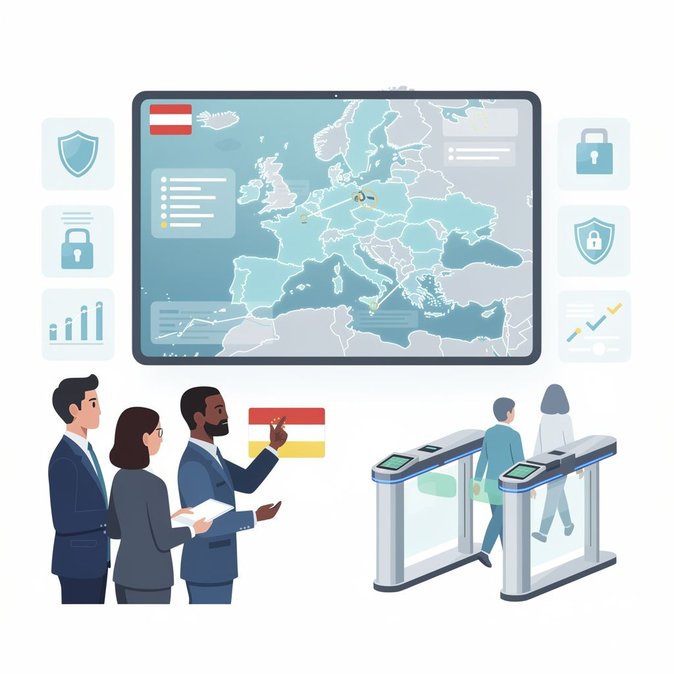
The Austrian federal government has presented the next stage of its "Reform Partnership" – a far-reaching digital-government package that officials say will move the country from “digital forms to truly digital services”. Announced on 17 June in Vienna, the initiative centres on expanding the Digital Austria Data Exchange hub (“dadeX”) so that authorities can re-use data they already hold instead of repeatedly asking applicants to resubmit it. By 2028, more than a dozen core registers – from the central residence register to social-insurance files – will be connected, allowing agencies to pull verified data in real time.
If navigating these forthcoming digital processes feels daunting, VisaHQ’s Austrian portal (https://www.visahq.com/austria/) already offers a single point of access for visa and permit requirements. The platform tracks evolving rules, pre-fills official forms where possible, and connects travellers and HR teams with vetted experts—helping organisations align their workflows with the once-only principle well before 2028.
For globally mobile employees and their HR teams, the reform matters because immigration, work-permit and social-security procedures sit squarely among the “high-volume, standardised transactions” that the package targets. Under the once-only principle, information supplied for a Red-White-Red Card application, for example, could automatically populate a subsequent family-reunification request or social-insurance registration, eliminating duplicate forms and reducing error rates. The legal backbone is an amendment to the General Administrative Procedures Act (AVG). This grants a statutory basis for fully automated decisions in straightforward cases and introduces “no-stop” procedures in which benefits or entitlements are issued automatically once statutory criteria are met. The government explicitly cites residence benefits, childcare allowances and tax refunds as early use-cases. Digital-by-default will also reshape appeals: updated administrative-court rules impose electronic filing standards and empower judges to order rapid fact-checks directly from connected registers. The aim is to cut the average case duration at provincial courts from today’s 11 months to “well under six”, according to State Secretary Alexander Pröll. For companies that relocate staff to Austria, the signal is clear: start preparing internal workflows for data re-use and machine-readable evidence. Authorities plan a phased roll-out, but large employers with high application volumes are likely to be invited into pilot schemes as early as 2027. Immigration advisers recommend mapping which documents – labour-market confirmations, degree certificates, proof of accommodation – could be issued or certified in digital form to gain an early-mover advantage.
If navigating these forthcoming digital processes feels daunting, VisaHQ’s Austrian portal (https://www.visahq.com/austria/) already offers a single point of access for visa and permit requirements. The platform tracks evolving rules, pre-fills official forms where possible, and connects travellers and HR teams with vetted experts—helping organisations align their workflows with the once-only principle well before 2028.
For globally mobile employees and their HR teams, the reform matters because immigration, work-permit and social-security procedures sit squarely among the “high-volume, standardised transactions” that the package targets. Under the once-only principle, information supplied for a Red-White-Red Card application, for example, could automatically populate a subsequent family-reunification request or social-insurance registration, eliminating duplicate forms and reducing error rates. The legal backbone is an amendment to the General Administrative Procedures Act (AVG). This grants a statutory basis for fully automated decisions in straightforward cases and introduces “no-stop” procedures in which benefits or entitlements are issued automatically once statutory criteria are met. The government explicitly cites residence benefits, childcare allowances and tax refunds as early use-cases. Digital-by-default will also reshape appeals: updated administrative-court rules impose electronic filing standards and empower judges to order rapid fact-checks directly from connected registers. The aim is to cut the average case duration at provincial courts from today’s 11 months to “well under six”, according to State Secretary Alexander Pröll. For companies that relocate staff to Austria, the signal is clear: start preparing internal workflows for data re-use and machine-readable evidence. Authorities plan a phased roll-out, but large employers with high application volumes are likely to be invited into pilot schemes as early as 2027. Immigration advisers recommend mapping which documents – labour-market confirmations, degree certificates, proof of accommodation – could be issued or certified in digital form to gain an early-mover advantage.