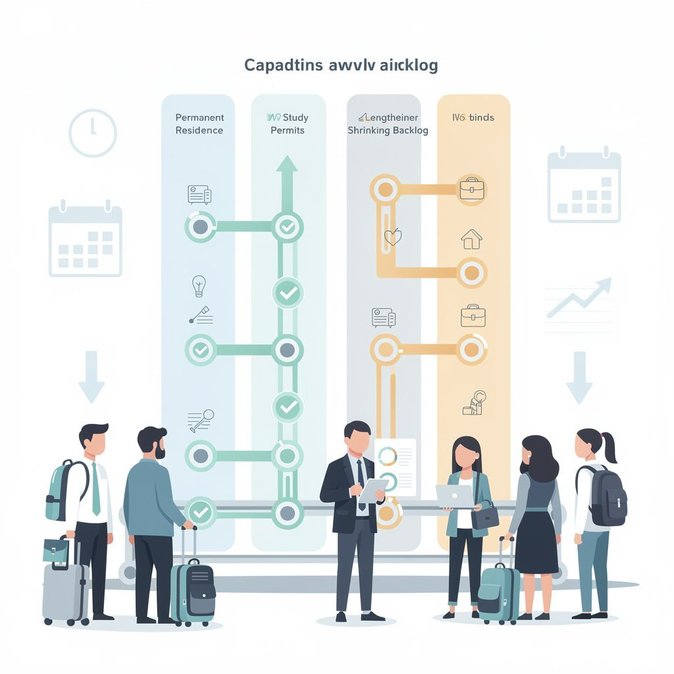
Canada’s immigration department has quietly reached an important service-standard milestone. In data released to stakeholder groups and analysed by Saskatchewan consultancy Guide Me Immigration, Immigration, Refugees and Citizenship Canada (IRCC) reported an overall inventory of 2.15 million files as of 30 April 2026, of which 1.23 million were being processed within published service standards. That leaves 922,700 files—about 43 % of the total—in the formal backlog, the smallest number since July 2025. Why the sudden progress? Officials credit three things: 1) a surge of overtime authorised in the winter federal budget, 2) expanded use of advanced analytics to triage “straight-forward” cases, and 3) the strategic pause, announced 1 January 2026, on the Start-Up Visa and other lower-priority economic pilots. The backlog improvements are most obvious in Express Entry, where only nine per cent of cases now exceed the six-month standard, down from 23 % a year ago. Study-permit backlogs also fell—from 40 % to 35 %—as Ottawa pushed to process files for the September academic intake. Work-permit inventories, by contrast, inched up to 37 % as employers rushed to file Labour Market Impact Assessments under revised wage rules. For employers and mobility managers the message is nuanced. Permanent-residence (PR) decisions for core economic classes are coming faster, which helps multinational firms retain temporary foreign workers who are nearing the four-year cumulative-work-period cap. Students should see more timely approvals, but companies that rely on LMIA-based work permits may experience longer waits through the summer hiring season. IRCC cautions that its “sustainability reset”—targeting 380,000 new PR admissions for 2026, down from 395,000 last year—means resources will stay tight and service standards will be enforced more strictly. Practically, global-mobility teams should revisit on-boarding timelines. A realistic expectation is six to eight weeks for most LMIA-exempt work permits, three to four months for LMIA-based permits, and six months for Express Entry PR once the Invitation to Apply has been accepted. Where mission-critical hires are involved, consider Canada’s Global Talent Stream or a provincial immigration fast track to hedge delays. Finally, remind candidates that biometrics and police certificates must be valid for the full processing window—expired supporting documents remain a leading cause of file re-routing into manual review, which adds months. IRCC says it will publish the next inventory snapshot in late July. If the positive trend holds, the department expects to reach its long-promised target of processing 80 % of applications within standard service times by the end of 2026.
Source: Guide Me Immigration