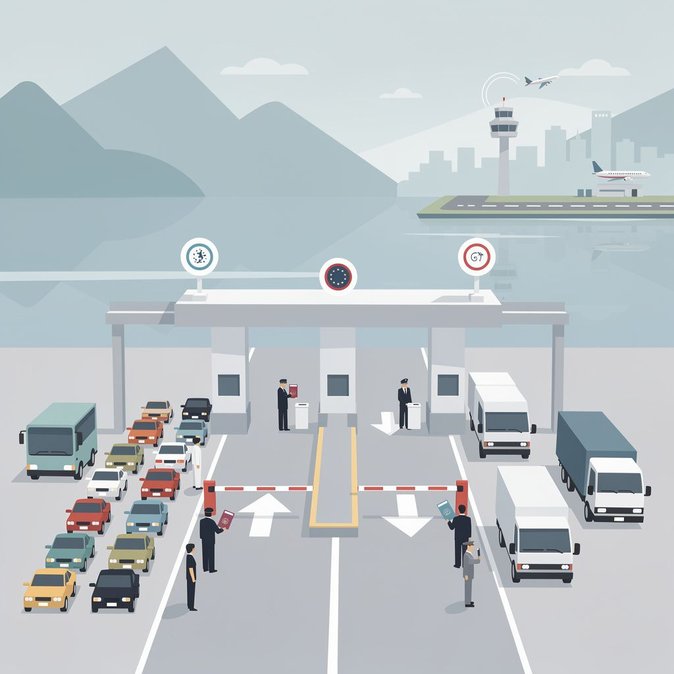
With the G7 leaders’ meeting taking place in Évian-les-Bains from 15 to 17 June, Swiss authorities reinstated Schengen-internal border controls with neighbouring France between 10 and 19 June 2026. For cross-border commuters and executives flying into Geneva Airport (GVA)—the main gateway for delegates—the most practical impact was that from 12 to 18 June only seven of the usual 35 road crossings around the Lake Geneva basin remained open.
For travelers who suddenly need to confirm document requirements or replace a lost passport, VisaHQ can help. The service’s France portal (https://www.visahq.com/france/) provides real-time updates on Schengen ID rules, alerts on temporary border measures, and expedited processing options—useful insurance for staff who may be blindsided by short-notice controls like those seen around the summit.
Travellers without a passport or national ID were turned back, catching out some EU nationals accustomed to ID-free movement. Average wait times at the two busiest crossings, Bardonnex (A1 motorway) and Ferney-Voltaire, peaked at 45 minutes in the morning of 16 June and again on summit-closing day, 17 June, before easing early on 18 June as delegations departed. Geneva Airport itself remained operational but operated under a reduced flow-rate imposed by a regional airspace restriction that expired at 03:00 on 18 June. The airport advised business-jet operators to slot-share or reposition to Lyon or Zurich. Several commercial carriers trimmed seat supply by switching wide-bodies to narrow-bodies; easyJet Europe cancelled three intra-EU rotations. For French employers in the Auvergne-Rhône-Alpes region the controls complicated daily commuting patterns. Many companies activated remote-work protocols for Swiss-resident staff, while logistics providers rerouted just-in-time deliveries via the Jura mountain crossings. Although temporary, the episode highlighted how quickly internal Schengen checks can re-emerge around high-profile events, and why HR departments need contingency plans for assignees living on one side of the border and working on the other. Border formalities returned to normal at midnight on 19 June, but Swiss officials warned that similar measures could be repeated during UEFA Euro 2028 and future high-security gatherings. Global mobility teams should maintain up-to-date passport-copy repositories and remind employees that national ID remains mandatory whenever internal checks are re-introduced—even inside the Schengen Area.
For travelers who suddenly need to confirm document requirements or replace a lost passport, VisaHQ can help. The service’s France portal (https://www.visahq.com/france/) provides real-time updates on Schengen ID rules, alerts on temporary border measures, and expedited processing options—useful insurance for staff who may be blindsided by short-notice controls like those seen around the summit.
Travellers without a passport or national ID were turned back, catching out some EU nationals accustomed to ID-free movement. Average wait times at the two busiest crossings, Bardonnex (A1 motorway) and Ferney-Voltaire, peaked at 45 minutes in the morning of 16 June and again on summit-closing day, 17 June, before easing early on 18 June as delegations departed. Geneva Airport itself remained operational but operated under a reduced flow-rate imposed by a regional airspace restriction that expired at 03:00 on 18 June. The airport advised business-jet operators to slot-share or reposition to Lyon or Zurich. Several commercial carriers trimmed seat supply by switching wide-bodies to narrow-bodies; easyJet Europe cancelled three intra-EU rotations. For French employers in the Auvergne-Rhône-Alpes region the controls complicated daily commuting patterns. Many companies activated remote-work protocols for Swiss-resident staff, while logistics providers rerouted just-in-time deliveries via the Jura mountain crossings. Although temporary, the episode highlighted how quickly internal Schengen checks can re-emerge around high-profile events, and why HR departments need contingency plans for assignees living on one side of the border and working on the other. Border formalities returned to normal at midnight on 19 June, but Swiss officials warned that similar measures could be repeated during UEFA Euro 2028 and future high-security gatherings. Global mobility teams should maintain up-to-date passport-copy repositories and remind employees that national ID remains mandatory whenever internal checks are re-introduced—even inside the Schengen Area.