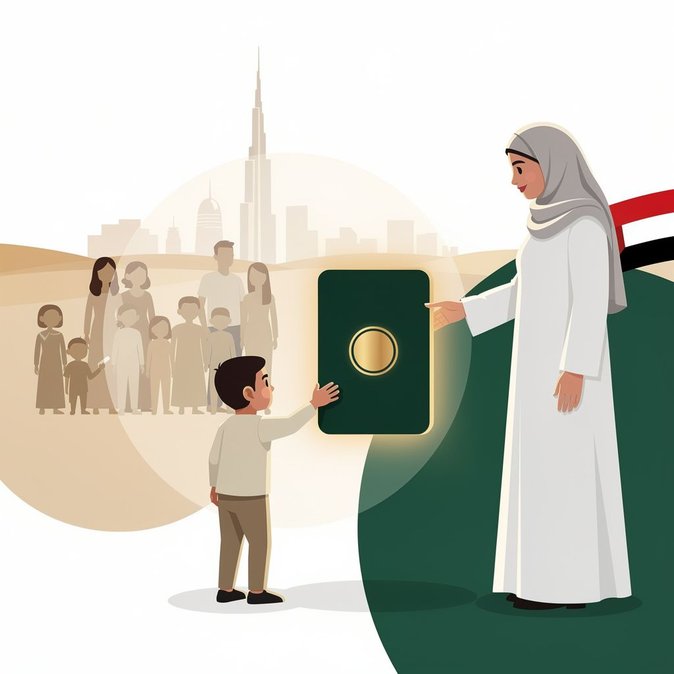
In a landmark decision announced on 19 June 2026, the committee tasked with implementing the President’s directives confirmed that 309 children born to Emirati mothers and foreign fathers have been approved for UAE citizenship. The move is part of a wider Emiratisation strategy that began in 2017, when the UAE first created a legal pathway for children of Emirati women to obtain nationality.
For families and employers navigating these changes, VisaHQ can help streamline the practical side of residency and travel documentation. Through our dedicated UAE page (https://www.visahq.com/united-arab-emirates/), users can verify current requirements, prepare visa applications, and track submissions in real time—valuable support that complements the new citizenship avenues now open to children of Emirati mothers.
Until then, citizenship was passed almost exclusively through the paternal line. According to officials, the latest batch of approvals follows exhaustive security and background checks carried out by the Ministry of Interior in cooperation with the Federal Authority for Identity, Citizenship, Customs & Port Security (ICP). Citizenship unlocks a full suite of benefits, including access to free public education and healthcare, the right to own land and property in any emirate, and eligibility for the highly regarded UAE passport. From a global-mobility perspective, the change also makes it easier for multinational employers to manage dependent sponsorships because newly naturalised individuals no longer require residence visas tied to a parent’s or guardian’s work permit. Analysts note that the latest approvals are timed to coincide with the UAE’s broader demographic goals. Emirati nationals currently represent roughly 11 percent of the population; boosting that share is seen as critical to long-term social cohesion. Employers should therefore expect continued policy tweaks that favour mixed-nationality families and simplify pathways to permanent status. Practically, HR teams should review any staff lists that include children of Emirati mothers who are still on dependent or student visas. Those individuals may now be eligible to convert to citizenship, eliminating future visa-renewal costs and easing international travel restrictions.
For families and employers navigating these changes, VisaHQ can help streamline the practical side of residency and travel documentation. Through our dedicated UAE page (https://www.visahq.com/united-arab-emirates/), users can verify current requirements, prepare visa applications, and track submissions in real time—valuable support that complements the new citizenship avenues now open to children of Emirati mothers.
Until then, citizenship was passed almost exclusively through the paternal line. According to officials, the latest batch of approvals follows exhaustive security and background checks carried out by the Ministry of Interior in cooperation with the Federal Authority for Identity, Citizenship, Customs & Port Security (ICP). Citizenship unlocks a full suite of benefits, including access to free public education and healthcare, the right to own land and property in any emirate, and eligibility for the highly regarded UAE passport. From a global-mobility perspective, the change also makes it easier for multinational employers to manage dependent sponsorships because newly naturalised individuals no longer require residence visas tied to a parent’s or guardian’s work permit. Analysts note that the latest approvals are timed to coincide with the UAE’s broader demographic goals. Emirati nationals currently represent roughly 11 percent of the population; boosting that share is seen as critical to long-term social cohesion. Employers should therefore expect continued policy tweaks that favour mixed-nationality families and simplify pathways to permanent status. Practically, HR teams should review any staff lists that include children of Emirati mothers who are still on dependent or student visas. Those individuals may now be eligible to convert to citizenship, eliminating future visa-renewal costs and easing international travel restrictions.