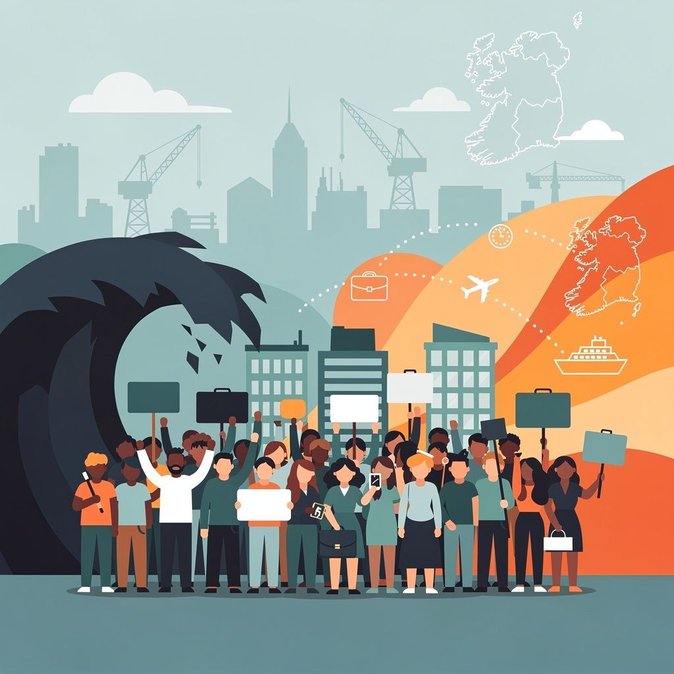
Thousands filled Belfast’s streets on 19 June 2026, forming what organisers called the city’s largest anti-racist mobilisation in a decade. Demonstrators carried “Migrants Are Welcome” banners past the burnt-out shells of vehicles torched during riots earlier in the week, after a knife attack involving an immigrant suspect triggered waves of xenophobic violence.
Similar solidarity rallies took place in Glasgow and Dublin.
Community leaders credit the rapid, peaceful response with halting a cycle of reprisals that had seen immigrant-owned shops and cars targeted in North Belfast and Newtownabbey.
Trade unions provided stewards, while Northern Ireland’s business chambers – keen to protect cross-border investment and EU workers – publicly endorsed the marches.
Police maintained a low-profile presence, mindful of criticism that earlier riots had been under-policed.
From a mobility perspective the episode underscores a risk often overlooked in assignment planning: localised social unrest can disrupt commuting routes, insurance coverage and employee wellbeing even when formal border controls are unchanged.
Several multinationals with back-office hubs in Belfast activated work-from-home protocols during the worst nights of violence, citing duty-of-care obligations to expatriate staff.
Irish relocation firms say the incident has prompted corporate clients to request updated security briefings for employees travelling between Dublin and Belfast under the Common Travel Area.
For organisations recalibrating travel policies in the wake of such disturbances, VisaHQ’s Ireland portal (https://www.visahq.com/ireland/) offers an easy way to verify entry requirements, arrange fast visa processing when necessary and sign up for real-time alerts on regulatory changes. Its corporate dashboard lets mobility teams track multiple travellers at once, ensuring compliance across Belfast-Dublin shuttle routes as well as longer-haul assignments.
Insurance brokers meanwhile report a spike in inquiries about policies covering civil-disorder damage to personal vehicles – a benefit rarely included in standard expatriate packages.
Civil-society groups hailed the day’s events as proof that rapid, non-violent collective action can out-number and out-message extremist actors.
For global-mobility managers the lesson is equally clear: political-risk mapping for Ireland must now factor in sporadic, social-media-fuelled flashpoints north of the border, even though the jurisdiction remains separate from the Republic.
Similar solidarity rallies took place in Glasgow and Dublin.
Community leaders credit the rapid, peaceful response with halting a cycle of reprisals that had seen immigrant-owned shops and cars targeted in North Belfast and Newtownabbey.
Trade unions provided stewards, while Northern Ireland’s business chambers – keen to protect cross-border investment and EU workers – publicly endorsed the marches.
Police maintained a low-profile presence, mindful of criticism that earlier riots had been under-policed.
From a mobility perspective the episode underscores a risk often overlooked in assignment planning: localised social unrest can disrupt commuting routes, insurance coverage and employee wellbeing even when formal border controls are unchanged.
Several multinationals with back-office hubs in Belfast activated work-from-home protocols during the worst nights of violence, citing duty-of-care obligations to expatriate staff.
Irish relocation firms say the incident has prompted corporate clients to request updated security briefings for employees travelling between Dublin and Belfast under the Common Travel Area.
For organisations recalibrating travel policies in the wake of such disturbances, VisaHQ’s Ireland portal (https://www.visahq.com/ireland/) offers an easy way to verify entry requirements, arrange fast visa processing when necessary and sign up for real-time alerts on regulatory changes. Its corporate dashboard lets mobility teams track multiple travellers at once, ensuring compliance across Belfast-Dublin shuttle routes as well as longer-haul assignments.
Insurance brokers meanwhile report a spike in inquiries about policies covering civil-disorder damage to personal vehicles – a benefit rarely included in standard expatriate packages.
Civil-society groups hailed the day’s events as proof that rapid, non-violent collective action can out-number and out-message extremist actors.
For global-mobility managers the lesson is equally clear: political-risk mapping for Ireland must now factor in sporadic, social-media-fuelled flashpoints north of the border, even though the jurisdiction remains separate from the Republic.