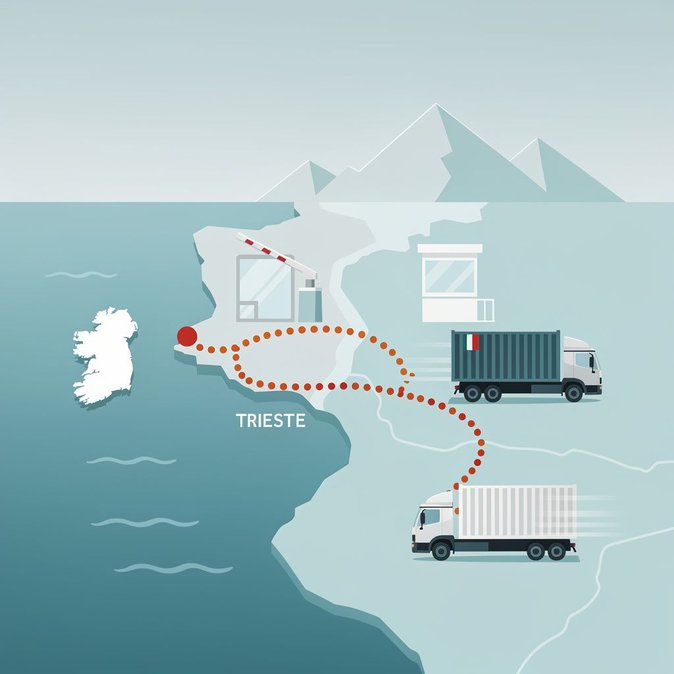
The European Commission’s Schengen dashboard shows that Italy’s internal border controls with Slovenia, first reinstated in December 2025 to counter migrant-smuggling, expired on 18 June 2026. The removal restores passport-free travel on the A34/A23 corridor—one of the most popular overland routes for Irish logistics firms trucking pharmaceuticals from the port of Trieste to central Europe. During the six-month suspension, hauliers faced wait times of up to three hours at Fernetti, adding cost and uncertainty to ‘landbridge’ supply chains that complement Ireland’s direct ferries to France and Spain.
For those still navigating shifting entry rules across Europe, VisaHQ’s Ireland portal (https://www.visahq.com/ireland/) can streamline the entire documentation process, from Schengen business visas to work permits. Its real-time tracking dashboard lets mobility managers and individual travellers monitor every stage of their application, reducing the risk of delays should border controls be reintroduced without much notice.
According to the Irish Road Haulage Association, members re-routed an estimated 600 consignments via Austria, incurring an average €420 extra per trailer. For business travellers, the change means that Irish engineers working on renewable-energy sites in Friuli or cross-border construction projects around Koper can again rely on same-day site visits without needing to carry passports for ad-hoc police stops. However, employers should note that Italy has warned it may reactivate checks ahead of the 2026 Winter Games if security threats re-emerge. The re-opening also has knock-on benefits for global-mobility teams planning household-goods moves by road. Relocation companies report that van lines paused through-routing via Slovenia due to insurance premiums linked to border queues; those surcharges—around €150 per container—are now expected to disappear, shaving several hundred euro off typical family-move budgets. Irish policymakers view the episode as a cautionary tale: while Ireland is not in Schengen, any drift toward routine internal-border suspensions elsewhere undermines the predictability on which exporters depend. The Department of Transport said it will push during the forthcoming EU Council Presidency for stricter proportionality tests before member states can reintroduce checks.

For those still navigating shifting entry rules across Europe, VisaHQ’s Ireland portal (https://www.visahq.com/ireland/) can streamline the entire documentation process, from Schengen business visas to work permits. Its real-time tracking dashboard lets mobility managers and individual travellers monitor every stage of their application, reducing the risk of delays should border controls be reintroduced without much notice.
According to the Irish Road Haulage Association, members re-routed an estimated 600 consignments via Austria, incurring an average €420 extra per trailer. For business travellers, the change means that Irish engineers working on renewable-energy sites in Friuli or cross-border construction projects around Koper can again rely on same-day site visits without needing to carry passports for ad-hoc police stops. However, employers should note that Italy has warned it may reactivate checks ahead of the 2026 Winter Games if security threats re-emerge. The re-opening also has knock-on benefits for global-mobility teams planning household-goods moves by road. Relocation companies report that van lines paused through-routing via Slovenia due to insurance premiums linked to border queues; those surcharges—around €150 per container—are now expected to disappear, shaving several hundred euro off typical family-move budgets. Irish policymakers view the episode as a cautionary tale: while Ireland is not in Schengen, any drift toward routine internal-border suspensions elsewhere undermines the predictability on which exporters depend. The Department of Transport said it will push during the forthcoming EU Council Presidency for stricter proportionality tests before member states can reintroduce checks.