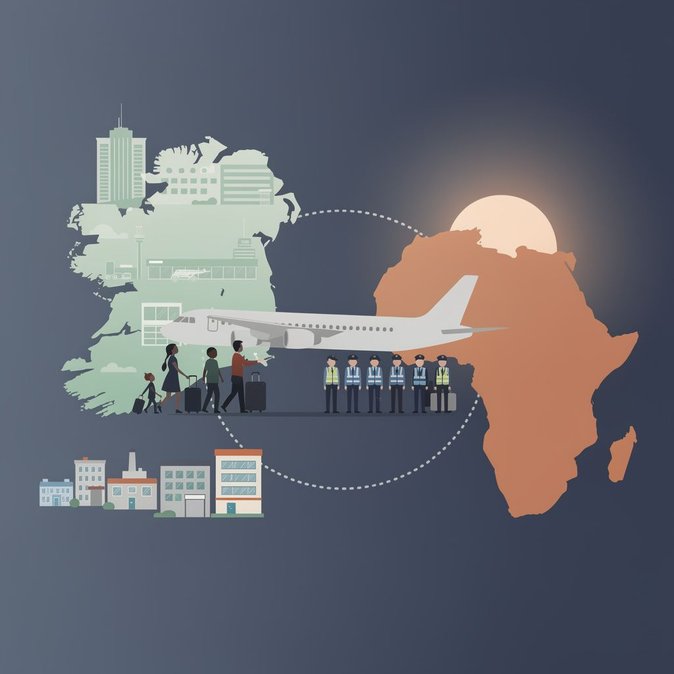
At 07:38 on Friday 19 June 2026, the Department of Justice confirmed that 42 South-African nationals – nine men, 18 women and 15 children – were removed from the State on a special charter flight to Johannesburg. The operation, executed by the Garda National Immigration Bureau (GNIB), is Ireland’s fourth mass-deportation flight of the year and cost the exchequer approximately €735,000 excluding VAT. Two of the adults had criminal convictions in Ireland; the remainder had exhausted all legal remedies against deportation. Justice Minister Jim O’Callaghan defended the expense, saying that “enforcement is an essential requirement for public confidence in a rules-based immigration system.” Minister of State Colm Brophy added that while migrants are vital to the Irish economy, “those who refuse to regularise their status cannot remain indefinitely.” Human-rights groups countered that family-unit removals place children at risk and urged the Government to publish individual risk assessments. A court-appointed human-rights observer travelled on board, fulfilling Ireland’s commitments under EU return-monitoring rules. For global‐mobility and assignment managers the headline is not the cost but the pace: deportation orders in 2026 have already reached 2,108, compared with 4,700 for the whole of 2025 – itself a 96 % jump on 2024. Companies sponsoring work permits must therefore double-check that employees’ permissions are renewed on time and that dependent family members’ statuses match the principal holder’s. Employers are also reminded that overstaying Irish permission automatically terminates a PPS number, invalidating payroll tax credits within 24 hours. Charter removals create logistical headaches for airlines: commercial carriers can refuse boarding to anyone subject to a live deportation order, but GNIB escorts sometimes appear at departure gates seeking seat allocations. Dublin Airport Authority confirmed it now blocks certain gates for 30 minutes when “large group removals” occur, potentially delaying morning transatlantic departures. Travel-management companies should monitor GNIB notifications to anticipate such bottlenecks. The political optics are equally stark. Coming a week after Ireland adopted the EU Migration Pact’s border-procedure pilot, mass removals signal a hardening stance that may complicate corporate diversity narratives. Mobility leaders will need to brief expatriate communities that strict enforcement can coexist with Ireland’s generally welcoming climate for legal migrants – provided paperwork is immaculate.
Source: The Journal