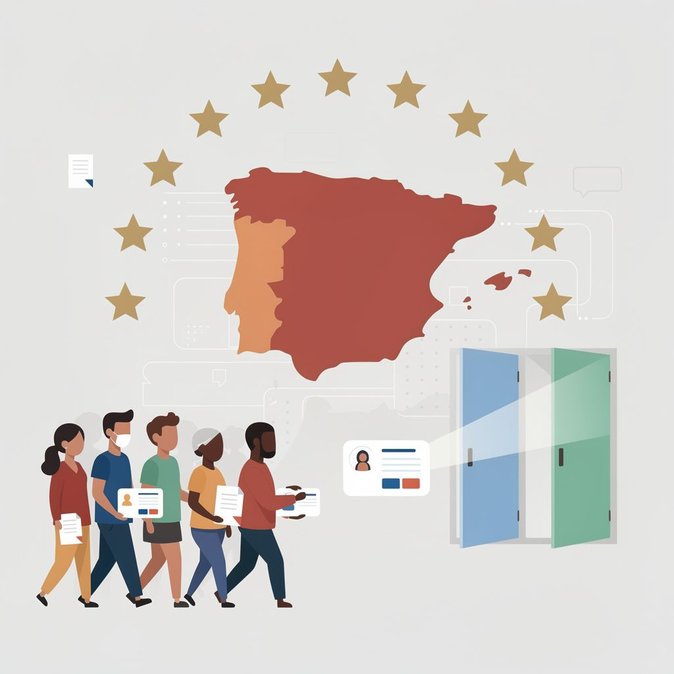
Spain’s long-debated extraordinary regularisation programme took a decisive step on 20 June 2026, when the Ministry of Inclusion confirmed that the scheme will indeed grant legal residence and work authorisation to around half-a-million foreign nationals who were already living in the country before 1 January 2026. Under Royal Decree 316/2026, applicants must prove at least five uninterrupted months of residence, show a clean criminal record in every country of residence for the previous five years and, where relevant, demonstrate basic language skills. Online filing opened on 16 April and in-person appointments began on 20 April at more than 430 Immigration, Social-Security and Correos offices.
For newcomers who do not qualify for the extraordinary programme but still need help navigating Spain’s complex visa rules, VisaHQ offers an easy-to-use portal (https://www.visahq.com/spain/) with step-by-step guidance for tourist, work and residence visas, document legalisation and appointment scheduling—streamlining paperwork so travellers and employers can focus on their plans rather than red tape.
The window closes at midnight on 30 June 2026 with no extension foreseen. Government sources speaking to Dialogue Migration on 20 June revealed that more than 910,000 files had already been created in the MERCURIO system—far above the initial 500,000 projection—and that 71 % of cases were complete enough to move into substantive review. Extra examiners from the National Police and Social-Security offices have been seconded to reduce backlogs; the ministry insists that “positive administrative silence” (automatic approval after 20 working days) will apply whenever legal deadlines are breached. For employers, the measure converts thousands of workers in agriculture, logistics, hospitality and home-care from the informal to the formal economy, easing skills shortages in regions such as Catalonia, Madrid and Valencia. HR teams must still issue standard employment offers within 60 days of approval so that new permit-holders can transition to ordinary work/residence status after the initial one-year card expires. From a mobility-policy perspective the Spanish initiative is being watched closely in Brussels: only eight days after the EU’s new Migration & Asylum Pact entered into force, Spain has chosen the opposite tack—regularising rather than accelerating removals. Business groups including CEOE and the American Chamber of Commerce in Spain have broadly welcomed the move, arguing it will widen the tax base and stabilise labour supply, although they stress the need for improved appointment capacity for biometric residence cards (TIEs) after approval.
For newcomers who do not qualify for the extraordinary programme but still need help navigating Spain’s complex visa rules, VisaHQ offers an easy-to-use portal (https://www.visahq.com/spain/) with step-by-step guidance for tourist, work and residence visas, document legalisation and appointment scheduling—streamlining paperwork so travellers and employers can focus on their plans rather than red tape.
The window closes at midnight on 30 June 2026 with no extension foreseen. Government sources speaking to Dialogue Migration on 20 June revealed that more than 910,000 files had already been created in the MERCURIO system—far above the initial 500,000 projection—and that 71 % of cases were complete enough to move into substantive review. Extra examiners from the National Police and Social-Security offices have been seconded to reduce backlogs; the ministry insists that “positive administrative silence” (automatic approval after 20 working days) will apply whenever legal deadlines are breached. For employers, the measure converts thousands of workers in agriculture, logistics, hospitality and home-care from the informal to the formal economy, easing skills shortages in regions such as Catalonia, Madrid and Valencia. HR teams must still issue standard employment offers within 60 days of approval so that new permit-holders can transition to ordinary work/residence status after the initial one-year card expires. From a mobility-policy perspective the Spanish initiative is being watched closely in Brussels: only eight days after the EU’s new Migration & Asylum Pact entered into force, Spain has chosen the opposite tack—regularising rather than accelerating removals. Business groups including CEOE and the American Chamber of Commerce in Spain have broadly welcomed the move, arguing it will widen the tax base and stabilise labour supply, although they stress the need for improved appointment capacity for biometric residence cards (TIEs) after approval.