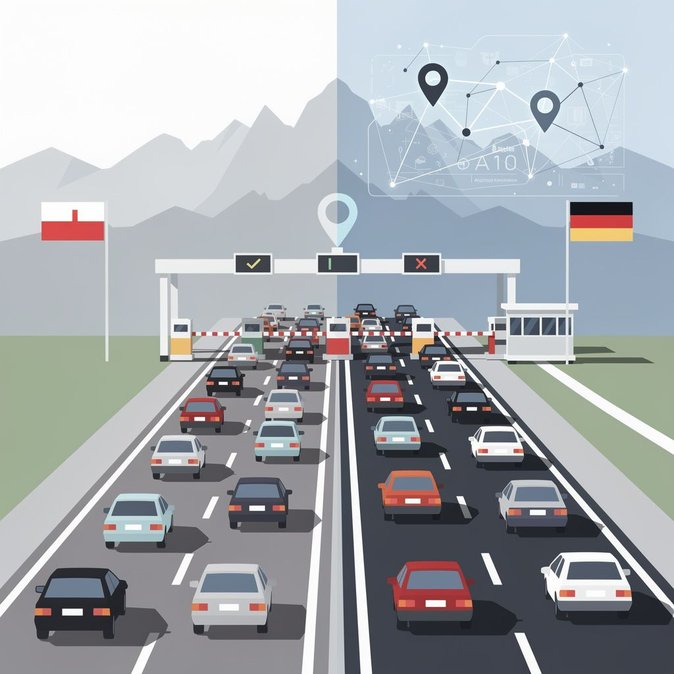
A Sunday morning in late June brought an all too familiar sight for travellers leaving Austria: a stationary line of vehicles stretching for kilometres along the Tauernautobahn (A10) toward the Walserberg checkpoint on the German border. According to Salzburg’s Kronen Zeitung, the end of school holidays in the German Länder of Bavaria and Baden-Württemberg triggered a mass northbound exodus on 21 June that instantly overwhelmed the motorway’s reduced lanes and the joint Austrian-German police inspection zone. Although Walserberg lies well inside Schengen territory, Germany has maintained “mobile” controls in the border area since 2015. Officers pull selected cars and coaches into inspection bays to check passports and vehicle documents, a process that safeguards against irregular migration and trafficking but slows throughput dramatically when volumes spike. Austrian traffic clubs ÖAMTC and ARBÖ warned in advance that the combination of construction works on the Tauern and the discretionary police checks could create stop-and-go conditions lasting several hours. The episode has reignited debate in Vienna and Brussels. The European Commission admonished nine member states earlier this month for failing to phase out internal Schengen checks, arguing that they should be replaced by intelligence-led “police cooperation in depth”. Austria, however, continues to support Germany’s stance, pointing to migrant smuggling routes through the Western Balkans and insisting that “border-zone surveillance” remains necessary. Interior-ministerial sources told the Kronen Zeitung that coordination centres allow German officers to ease controls temporarily when tailbacks exceed a critical length, but drivers complained on social media that this measure comes too late to save missed flights or meetings. For corporate mobility managers the lesson is clear: summer weekend road journeys between Austria and Germany remain unpredictable. Employers sending project teams to Munich or Salzburg often opt for rail—daytime Railjet services require no formal border checks and rarely suffer heavy delays. Those who must drive should avoid peak return windows (Saturday afternoon through late Sunday) or reroute via the Pyhrn (A9) or Kufstein (A12) corridors, which currently see fewer spot checks. Longer term, business-travel stakeholders are lobbying both governments to accelerate the move toward fully automated Entry/Exit System (EES) and ETIAS controls at the external EU frontier rather than at internal crossings. Until that migration-management upgrade is complete, episodic jams like Sunday’s will continue to erode the time-savings that normally make cross-border road travel attractive in the heart of Europe.
Source: Kronen Zeitung