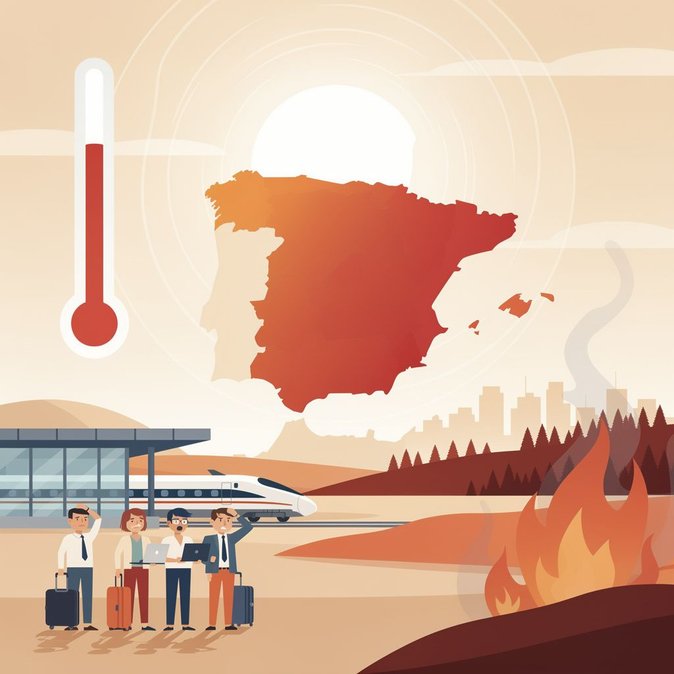
Spain ushered in summer with an immediate meteorological challenge: on 21 June, the State Meteorological Agency (AEMET) activated red and orange alerts for extreme heat across eleven autonomous communities, as reported by Moncloa.com. Temperatures were forecast to approach 40 °C in the interior of the Basque Country and major river valleys, with night-time lows staying above 25 °C in parts of Andalusia and the Ebro corridor. The agency warned that the episode, fuelled by a Saharan air mass, would intensify through 24 June, when 1,650 municipalities could face ‘extreme’ wildfire risk.
If you’re planning urgent travel to Spain during this period, VisaHQ can streamline the visa and documentation process so you spend less time queuing at consulates and more time monitoring the evolving situation. Their Spain portal (https://www.visahq.com/spain/) offers step-by-step guidance on Schengen visa requirements, digital health declarations and embassy appointment scheduling—valuable tools when heat-related disruptions force last-minute itinerary changes.
For international travellers and assignees, the alerts carry concrete implications. Civil-protection authorities advise limiting outdoor activity, staying in air-conditioned accommodation and monitoring rail or road closures near forested areas. Airlines operating into Seville, Málaga and Zaragoza airports have already issued flexible-rebooking policies for passengers whose onward train connections might be disrupted by heat-related speed restrictions on RENFE services. Cruise lines home-porting in Barcelona on 23–25 June have told passengers to expect itinerary adjustments if wildfire smoke affects coastal visibility. Employers with field staff should activate heat-stress protocols: adjust work schedules to early-morning hours, provide hydration stations and confirm that health insurance covers heat-stroke treatment. Business-continuity planners may need to reroute ground-transport suppliers; last summer, a similar heatwave forced temporary closures on the A-7 and A-66 motorways. Logistics operators should monitor regional governments’ real-time fire-risk maps, as heavy-goods vehicles over 7.5 t can be banned from certain mountain passes when alerts reach level 4. Looking ahead, climate scientists at AEMET note that each of the past five years has brought at least one major June heatwave, shortening the comfortable travel window for conferences and corporate events. Destination-management companies now recommend hybrid-event formats or shifting incentive trips to late spring or early autumn. The 2026 experience reinforces pressure on Spain’s tourism and transport sectors to invest in heat-resilient infrastructure—from shaded airport jet-bridges to higher-tolerance rail track materials—if the country is to preserve its status as Europe’s number-one holiday destination.
If you’re planning urgent travel to Spain during this period, VisaHQ can streamline the visa and documentation process so you spend less time queuing at consulates and more time monitoring the evolving situation. Their Spain portal (https://www.visahq.com/spain/) offers step-by-step guidance on Schengen visa requirements, digital health declarations and embassy appointment scheduling—valuable tools when heat-related disruptions force last-minute itinerary changes.
For international travellers and assignees, the alerts carry concrete implications. Civil-protection authorities advise limiting outdoor activity, staying in air-conditioned accommodation and monitoring rail or road closures near forested areas. Airlines operating into Seville, Málaga and Zaragoza airports have already issued flexible-rebooking policies for passengers whose onward train connections might be disrupted by heat-related speed restrictions on RENFE services. Cruise lines home-porting in Barcelona on 23–25 June have told passengers to expect itinerary adjustments if wildfire smoke affects coastal visibility. Employers with field staff should activate heat-stress protocols: adjust work schedules to early-morning hours, provide hydration stations and confirm that health insurance covers heat-stroke treatment. Business-continuity planners may need to reroute ground-transport suppliers; last summer, a similar heatwave forced temporary closures on the A-7 and A-66 motorways. Logistics operators should monitor regional governments’ real-time fire-risk maps, as heavy-goods vehicles over 7.5 t can be banned from certain mountain passes when alerts reach level 4. Looking ahead, climate scientists at AEMET note that each of the past five years has brought at least one major June heatwave, shortening the comfortable travel window for conferences and corporate events. Destination-management companies now recommend hybrid-event formats or shifting incentive trips to late spring or early autumn. The 2026 experience reinforces pressure on Spain’s tourism and transport sectors to invest in heat-resilient infrastructure—from shaded airport jet-bridges to higher-tolerance rail track materials—if the country is to preserve its status as Europe’s number-one holiday destination.