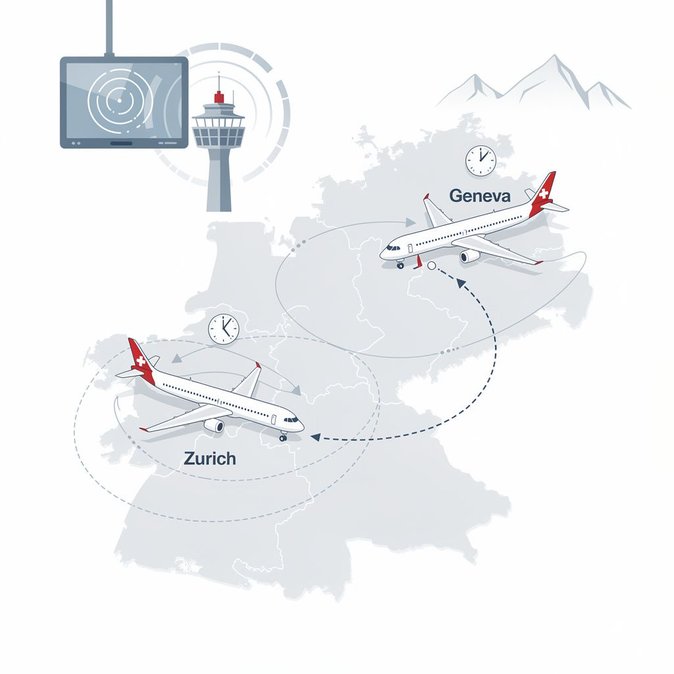
By early Monday, 22 June, Swiss airspace was technically back to normal — yet the operational hang-over from Sunday’s Skyguide outage was still being felt. The Gulf Time, citing Bloomberg data, reported that Switzerland’s skies were closed from 06:30 to just after 08:30, the first nationwide shutdown since 2022. Zurich Airport said departures only reached the customary 28-movements-per-hour benchmark shortly before noon, and Eurocontrol warned carriers to expect rotational knock-on delays across intra-European networks for the rest of the day.
For travelers who suddenly need to reroute or secure last-minute entry documentation because of such disruptions, VisaHQ’s Switzerland portal (https://www.visahq.com/switzerland/) can streamline the process with same-day visa assistance, real-time status alerts and tailored guidance on Schengen transit rules—helping companies and their mobile staff pivot quickly while maintaining compliance.
Travel-management companies (TMCs) told clients to monitor flights bound for trans-Atlantic banks on Monday evening, when crew-duty-time limits risked secondary cancellations. Freight forwarders re-routed temperature-sensitive pharma consignments through Basel-Mulhouse and Frankfurt, pointing out that Zurich’s cargo backlog would take at least 24 hours to clear. Skyguide has opened an internal investigation and notified the Swiss Transportation Safety Investigation Board (STSB). While officials stress there is “no evidence of a cyberattack,” the National Cybersecurity Centre has been asked to provide forensic support, reflecting heightened concern after several ransomware probes into Swiss critical infrastructure this year. Early indications suggest a software compatibility fault between the legacy radar-processing platform and a new digital no-fly-zone overlay used for VIP events. From a compliance perspective, companies with duty-of-care obligations should update risk logs to reflect potential cascading failures in Swiss ATC systems. Insurance brokers say policies that cover ‘travel delay due to air-traffic system failure’ may apply, but only if travellers kept documentary proof of check-in times. Meanwhile, business-aviation operators are lobbying the Federal Office of Civil Aviation (FOCA) to accelerate contingency planning for rerouting corporate jets to regional airports such as St. Gallen-Altenrhein or Bern-Belp during future outages.
For travelers who suddenly need to reroute or secure last-minute entry documentation because of such disruptions, VisaHQ’s Switzerland portal (https://www.visahq.com/switzerland/) can streamline the process with same-day visa assistance, real-time status alerts and tailored guidance on Schengen transit rules—helping companies and their mobile staff pivot quickly while maintaining compliance.
Travel-management companies (TMCs) told clients to monitor flights bound for trans-Atlantic banks on Monday evening, when crew-duty-time limits risked secondary cancellations. Freight forwarders re-routed temperature-sensitive pharma consignments through Basel-Mulhouse and Frankfurt, pointing out that Zurich’s cargo backlog would take at least 24 hours to clear. Skyguide has opened an internal investigation and notified the Swiss Transportation Safety Investigation Board (STSB). While officials stress there is “no evidence of a cyberattack,” the National Cybersecurity Centre has been asked to provide forensic support, reflecting heightened concern after several ransomware probes into Swiss critical infrastructure this year. Early indications suggest a software compatibility fault between the legacy radar-processing platform and a new digital no-fly-zone overlay used for VIP events. From a compliance perspective, companies with duty-of-care obligations should update risk logs to reflect potential cascading failures in Swiss ATC systems. Insurance brokers say policies that cover ‘travel delay due to air-traffic system failure’ may apply, but only if travellers kept documentary proof of check-in times. Meanwhile, business-aviation operators are lobbying the Federal Office of Civil Aviation (FOCA) to accelerate contingency planning for rerouting corporate jets to regional airports such as St. Gallen-Altenrhein or Bern-Belp during future outages.