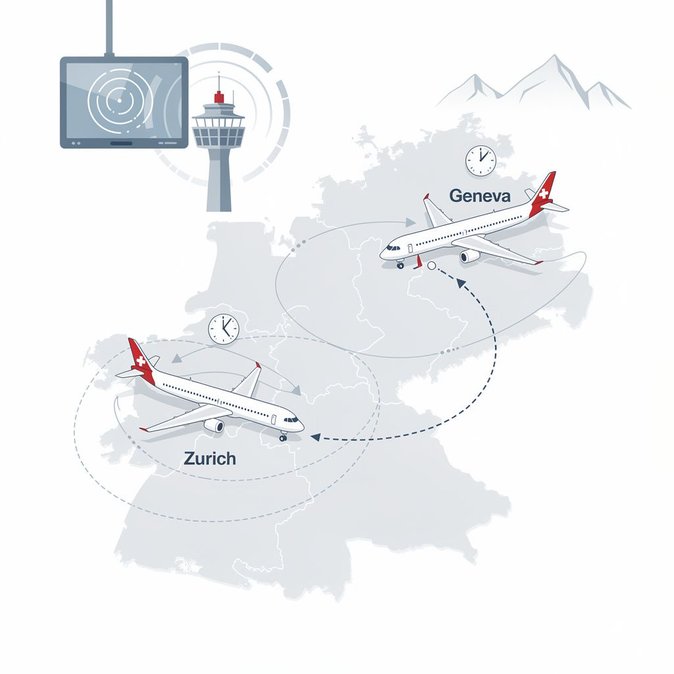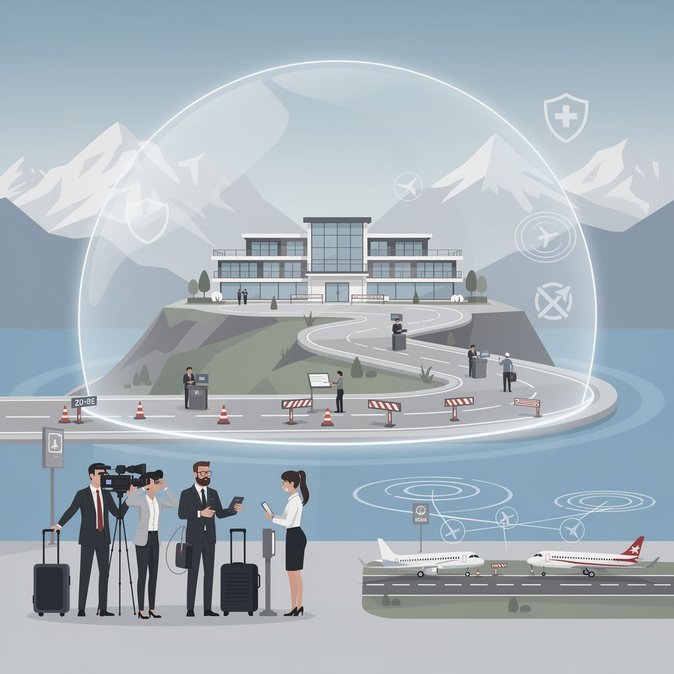
Switzerland’s image as a neutral host for world diplomacy was on full display this weekend as vice-president JD Vance, Iranian parliamentary speaker Mohammad Bagher Qalibaf and mediators from Qatar and Pakistan converged on the mountaintop Bürgenstock resort above Lake Lucerne. Axios reports that the talks began on Saturday and ran non-stop into Sunday night, marking the first 60-day phase of an ambitious roadmap toward a permanent cease-fire and a new nuclear framework. A separate AFP dispatch confirmed that Iran’s advance delegation landed late Saturday on a chartered Mahan Air A340, using a diplomatic corridor cleared by Swiss authorities. The influx of VIP flights required a multilayered security and mobility plan. Swiss air-traffic control created a rolling 40-nautical-mile temporary restricted area (TRA) around the resort, while the Federal Police set up passport pre-clearance zones for delegations arriving at Zurich and Buochs military airfield. Commercial passengers saw the effects most clearly in the form of the radar glitch that closed Swiss airspace for two hours on Sunday morning, but security cordons also extended to the lakeside Bürgenstock funicular and to segments of the A2 motorway, where mobile checkpoints inspected diplomatic convoys. For multinational companies headquartered in the Zurich-Lucerne corridor, the summit translated into concrete mobility challenges: last-minute hotel over-bookings, diverted VIP shuttles, and tightened drone-flight restrictions that delayed construction-site surveys and media shoots. Ground-handlers at Zurich told the Swiss Business Aviation Association that half a dozen corporate aircraft had to reposition to Basel or Friedrichshafen because all high-security parking stands were reserved for state jets. Swiss authorities have become adept at ‘event mode’ operations after hosting the 2024 Ukraine Summit at the same venue, but legal experts note that the current gathering operates outside the Schengen Facilitation Directive, meaning standard visa rules still apply to non-diplomatic support staff. HR teams moving media crews or technical consultants to the resort therefore need to budget extra lead-time for short-stay C-visa appointments. Looking ahead, the FOCA has published a draft circular that would streamline the issuance of “summit passes” — single-entry border permits valid only for accredited event personnel — a move welcomed by conference organisers. Should the U.S.–Iran talks progress to a formal signing ceremony later this summer, travel managers can expect another round of airspace restrictions, and possibly an extension of the current TRA to cover Geneva, where follow-up meetings of the High-Level Committee are pencilled in for August.
Source: Axios