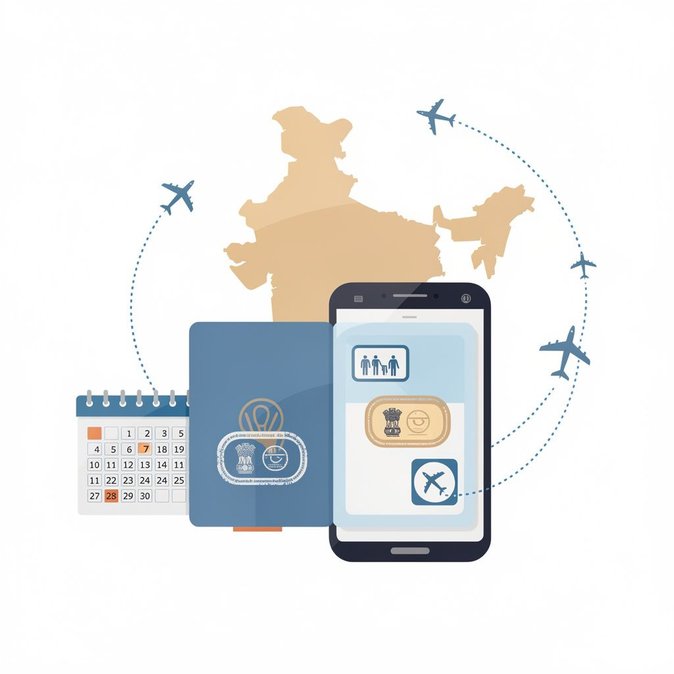
The Ministry of Home Affairs quietly updated its e-Visa portal on 24 June, expanding the validity of the standard e-Tourist Visa from 60 days to 120 days and allowing unlimited entries within that period. Travellers who received approvals after 12 June have already reported seeing “Multiple Entries” printed on their electronic travel authorisations. The policy shift comes after feedback from tourism stakeholders that the 60-day, double-entry limit discouraged repeat regional hops—a growing trend among digital nomads and South-East Asian holiday-makers who combine India with Sri Lanka or Nepal.
For travellers who want help navigating these freshly released rules, VisaHQ offers a streamlined online service that checks your eligibility, auto-fills the updated forms and tracks your application status; its dedicated India page (https://www.visahq.com/india/) is updated daily and can save you from missed details or avoidable rejections.
The longer window also aligns India with ASEAN competitors such as Thailand that offer 90-day visas on arrival. Operationally, nothing else changes: applications must still be submitted at least four days before travel, biometric capture remains on arrival, and entry is restricted to 32 designated airports and six seaports. Fees have not risen, but airlines have been asked to update check-in systems to flag the new 120-day rule. For businesses, the move simplifies short-term assignment logistics. Regional sales managers can make multiple back-and-forth trips on a single authorisation, reducing paperwork costs. Cruise operators home-porting in Mumbai and Kochi also expect smoother embarkation for passengers who last year had to apply for fresh permits after shore excursions to Malé or Dubai. Immigration lawyers caution that the extension does not confer right to work; holders engaging in remunerated activity still require an Employment or Business Visa. Overstays accrue a US $300 fine per month, and all travellers must carry a print-out of the e-Visa approval to present at border control.
For travellers who want help navigating these freshly released rules, VisaHQ offers a streamlined online service that checks your eligibility, auto-fills the updated forms and tracks your application status; its dedicated India page (https://www.visahq.com/india/) is updated daily and can save you from missed details or avoidable rejections.
The longer window also aligns India with ASEAN competitors such as Thailand that offer 90-day visas on arrival. Operationally, nothing else changes: applications must still be submitted at least four days before travel, biometric capture remains on arrival, and entry is restricted to 32 designated airports and six seaports. Fees have not risen, but airlines have been asked to update check-in systems to flag the new 120-day rule. For businesses, the move simplifies short-term assignment logistics. Regional sales managers can make multiple back-and-forth trips on a single authorisation, reducing paperwork costs. Cruise operators home-porting in Mumbai and Kochi also expect smoother embarkation for passengers who last year had to apply for fresh permits after shore excursions to Malé or Dubai. Immigration lawyers caution that the extension does not confer right to work; holders engaging in remunerated activity still require an Employment or Business Visa. Overstays accrue a US $300 fine per month, and all travellers must carry a print-out of the e-Visa approval to present at border control.