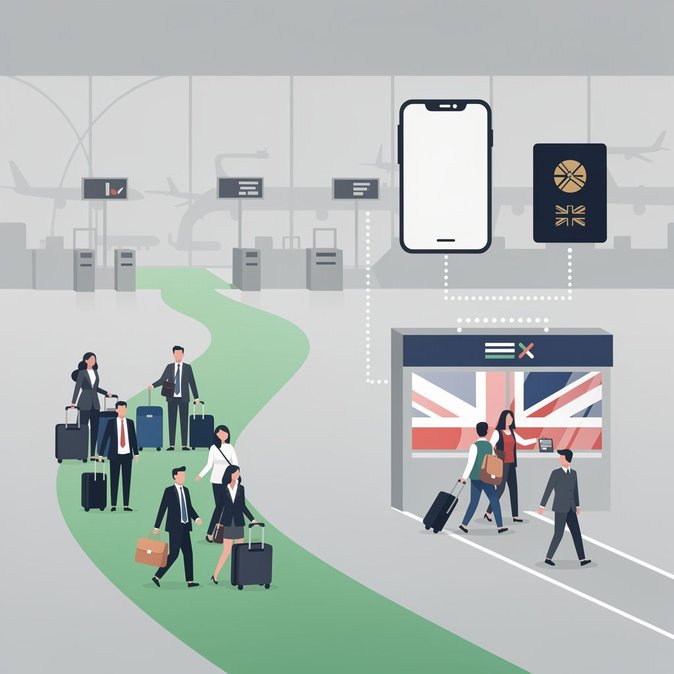
Travellers consulting Qsensor’s live passport-control dashboard for Heathrow Terminal 3 on 27 June noticed an important policy footnote: passengers whose itineraries qualify for ‘airside’ transit remain “temporarily exempt” from the UK’s new Electronic Travel Authorisation (ETA) requirement.
Whether you’re a corporate travel manager or an individual flyer, VisaHQ can quickly determine if you need an ETA and, when required, complete the application on your behalf. The service’s UK portal (https://www.visahq.com/united-kingdom/) offers real-time eligibility checks, clear step-by-step guidance, and bulk-processing tools that simplify compliance for teams moving staff through Heathrow or any other British airport.
The real-time advisory, updated at 20:01 BST alongside queue-time metrics, confirms industry guidance that an ETA is needed only if a traveller passes UK border control—whether to collect bags, re-check with a different airline, or enter the country. Since February, citizens of 85 visa-exempt nations (including all EU member states, the US and Australia) have had to hold an approved ETA before boarding a flight to the UK. Confusion has persisted among travel agents and even some carriers about whether the permit is compulsory for same-ticket connections that keep passengers within the secure departures area. Heathrow’s data partner now explicitly states that airside transit falls outside the scheme "for the time being", pending a Home Office review later this year. For mobility and travel-risk teams the clarification is significant. Companies moving talent through the UK on complex multi-stop routings can avoid £20 ETA fees and potential boarding denials provided itineraries remain on one ticket and bags are interlined. However, any disruption that forces a landside re-check—such as mis-connected bags or schedule changes—would instantly trigger ETA (or visa) requirements, so contingency planning is essential. The same dashboard showed non-EEA passport-control waits oscillating between five minutes and 90 minutes during the day, underscoring the value of live-data tools for traveller briefings. Organisations with large transient workforces should integrate such feeds into mobile apps or chatbots, allowing employees to time their arrival and reduce missed-connection risk as UK borders progressively digitise.
Whether you’re a corporate travel manager or an individual flyer, VisaHQ can quickly determine if you need an ETA and, when required, complete the application on your behalf. The service’s UK portal (https://www.visahq.com/united-kingdom/) offers real-time eligibility checks, clear step-by-step guidance, and bulk-processing tools that simplify compliance for teams moving staff through Heathrow or any other British airport.
The real-time advisory, updated at 20:01 BST alongside queue-time metrics, confirms industry guidance that an ETA is needed only if a traveller passes UK border control—whether to collect bags, re-check with a different airline, or enter the country. Since February, citizens of 85 visa-exempt nations (including all EU member states, the US and Australia) have had to hold an approved ETA before boarding a flight to the UK. Confusion has persisted among travel agents and even some carriers about whether the permit is compulsory for same-ticket connections that keep passengers within the secure departures area. Heathrow’s data partner now explicitly states that airside transit falls outside the scheme "for the time being", pending a Home Office review later this year. For mobility and travel-risk teams the clarification is significant. Companies moving talent through the UK on complex multi-stop routings can avoid £20 ETA fees and potential boarding denials provided itineraries remain on one ticket and bags are interlined. However, any disruption that forces a landside re-check—such as mis-connected bags or schedule changes—would instantly trigger ETA (or visa) requirements, so contingency planning is essential. The same dashboard showed non-EEA passport-control waits oscillating between five minutes and 90 minutes during the day, underscoring the value of live-data tools for traveller briefings. Organisations with large transient workforces should integrate such feeds into mobile apps or chatbots, allowing employees to time their arrival and reduce missed-connection risk as UK borders progressively digitise.