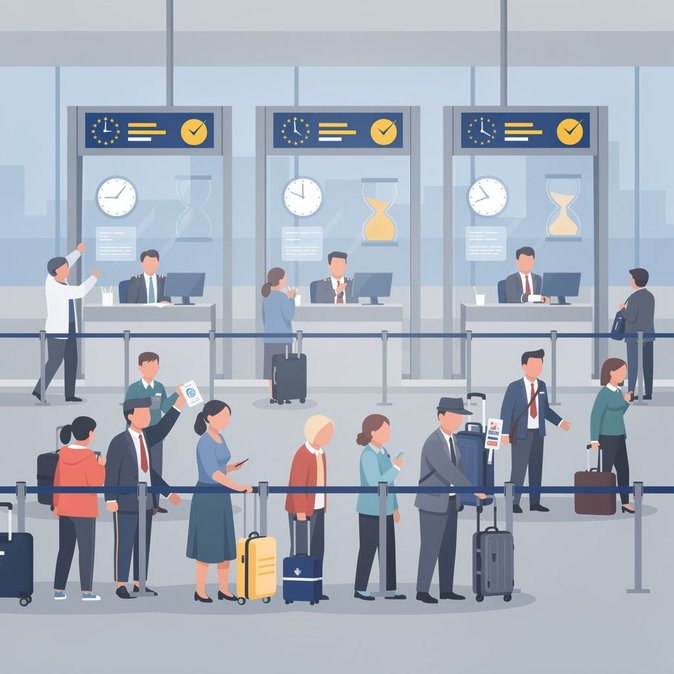
With peak summer traffic looming, European airport operators are warning that the EU’s new biometric Entry/Exit System (EES) is buckling under load, raising the spectre of six-hour immigration queues for British nationals. A report by Italian newswire Teleborsa quotes Aeroporti di Roma’s CEO Marco Troncone saying Fiumicino and Ciampino may have to suspend EES processing at times to avoid “chaos”, while ACI Europe president Stefan Schulte told the BBC politicians must “stop pretending the system works”. EES became fully operational on 10 April 2026 and requires all non-EU visitors—including UK passport-holders—to provide fingerprints and a facial scan the first time they cross an external Schengen border.
For travellers and mobility coordinators who need help navigating these evolving EU entry rules, VisaHQ provides step-by-step support, from clarifying documentation to assisting with pre-registration apps and fast-track services. Their UK platform (https://www.visahq.com/united-kingdom/) lets individuals and corporations arrange visas, passports and compliance checks online, reducing the risk of being caught out by EES bottlenecks.
Airlines, however, claim teething problems with self-service kiosks mean many passengers have to repeat the procedure or are funnelled into manual desks, negating any efficiency gains. IATA modelling cited in the article suggests worst-case queue times of up to six hours at the busiest hubs if throughput is not improved before the late-July surge. Greece has already seen a Ryanair flight to London depart half-empty because passengers could not be processed in time. Similar flashpoints in Spain and France would strand both holidaymakers and business travellers at height of season. The European Commission insists the rules allow flexibility and that staff shortages, not technology, are the main bottleneck. But only two member states—Sweden and Portugal—have so far activated the ‘Travel to Europe’ pre-registration app designed to speed enrolment, and UK travel association ABTA says its members are fielding a rising volume of client complaints. Companies with essential travel to the EU should advise employees to allow extra time at the border, ensure passport chips are undamaged and, where available, use pre-enrolment apps. Mobility teams may also wish to stagger arrival dates for group moves into Schengen states until operational reliability improves or exemption measures are agreed.
For travellers and mobility coordinators who need help navigating these evolving EU entry rules, VisaHQ provides step-by-step support, from clarifying documentation to assisting with pre-registration apps and fast-track services. Their UK platform (https://www.visahq.com/united-kingdom/) lets individuals and corporations arrange visas, passports and compliance checks online, reducing the risk of being caught out by EES bottlenecks.
Airlines, however, claim teething problems with self-service kiosks mean many passengers have to repeat the procedure or are funnelled into manual desks, negating any efficiency gains. IATA modelling cited in the article suggests worst-case queue times of up to six hours at the busiest hubs if throughput is not improved before the late-July surge. Greece has already seen a Ryanair flight to London depart half-empty because passengers could not be processed in time. Similar flashpoints in Spain and France would strand both holidaymakers and business travellers at height of season. The European Commission insists the rules allow flexibility and that staff shortages, not technology, are the main bottleneck. But only two member states—Sweden and Portugal—have so far activated the ‘Travel to Europe’ pre-registration app designed to speed enrolment, and UK travel association ABTA says its members are fielding a rising volume of client complaints. Companies with essential travel to the EU should advise employees to allow extra time at the border, ensure passport chips are undamaged and, where available, use pre-enrolment apps. Mobility teams may also wish to stagger arrival dates for group moves into Schengen states until operational reliability improves or exemption measures are agreed.