China’s domestically manufactured C909 regional jet celebrated its tenth year in commercial service on 28 June. According to the Transport Ministry’s official newspaper, 186 aircraft now fly for more than ten Chinese carriers, having opened 860 routes and carried 37 million passengers since 2016.
If your organisation wants to tap into the expanding network of C909 “Frontier Express” flights, VisaHQ can simplify the cross-border paperwork. Through our easy online portal (https://www.visahq.com/china/), travellers can obtain Chinese, Kazakh, Mongolian and Russian visas in one streamlined workflow, helping mobility managers keep crews and project teams moving without delays.
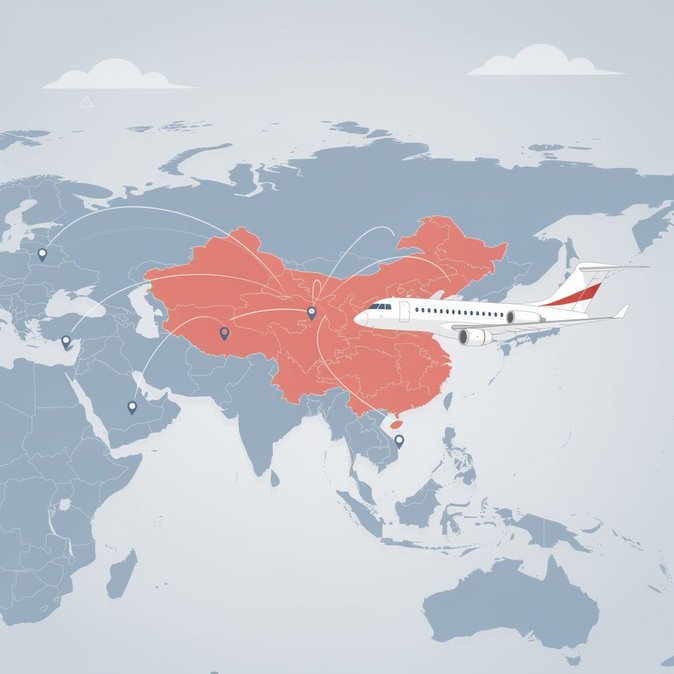
What began as a feeder aircraft has evolved into a tool of diplomacy and trade: nearly one-third of C909 flights now operate on “border-bridge” sectors linking frontier cities such as Horgos, Manzhouli and Heihe with destinations in Kazakhstan, Mongolia and Russia. Under the “边疆快线” (Frontier Express) programme, Xinjiang alone operates 120 C909 flights a day, with half continuing onward to Almaty, Bishkek or Tashkent. This has cut travel time for cross-border technicians and small-parcel freight from three days by road to under four hours. The model echoes the European Union’s “public-service obligation” air routes, ensuring regular connectivity where surface links are slow or seasonally closed. The aircraft’s low runway requirements and 110-seat configuration make it ideal for secondary airports. Airlines report load factors above 78 percent on newly launched international sectors, thanks to China’s 30-day visa-free entry for 50-plus countries and reciprocal waivers from Central Asian partners. Freight forwarders are also booking C909 belly-hold capacity to move high-value electronics and perishables between Ürümqi and Moscow. Looking ahead, manufacturer COMAC plans a stretch version with 3 000-kilometre range, which would enable direct flights from Kunming to Singapore or from Harbin to Tokyo Haneda, further blurring the line between regional and mainline networks. Aviation authorities have hinted that C909 operators meeting punctuality and safety targets will receive automatic traffic-rights approvals for “周边国际” (near-neighbour international) routes—policy support that could accelerate route proliferation. For global-mobility managers, the C909’s success means greater redundancy in China’s domestic-to-international feed, reducing missed-connection risk and opening new one-stop itineraries for staff travelling to belt-and-road markets. Companies should monitor fare trends: introductory promotional pricing on C909 border flights can undercut traditional full-service carriers by up to 30 percent, offering cost-saving opportunities for project teams.
If your organisation wants to tap into the expanding network of C909 “Frontier Express” flights, VisaHQ can simplify the cross-border paperwork. Through our easy online portal (https://www.visahq.com/china/), travellers can obtain Chinese, Kazakh, Mongolian and Russian visas in one streamlined workflow, helping mobility managers keep crews and project teams moving without delays.
What began as a feeder aircraft has evolved into a tool of diplomacy and trade: nearly one-third of C909 flights now operate on “border-bridge” sectors linking frontier cities such as Horgos, Manzhouli and Heihe with destinations in Kazakhstan, Mongolia and Russia. Under the “边疆快线” (Frontier Express) programme, Xinjiang alone operates 120 C909 flights a day, with half continuing onward to Almaty, Bishkek or Tashkent. This has cut travel time for cross-border technicians and small-parcel freight from three days by road to under four hours. The model echoes the European Union’s “public-service obligation” air routes, ensuring regular connectivity where surface links are slow or seasonally closed. The aircraft’s low runway requirements and 110-seat configuration make it ideal for secondary airports. Airlines report load factors above 78 percent on newly launched international sectors, thanks to China’s 30-day visa-free entry for 50-plus countries and reciprocal waivers from Central Asian partners. Freight forwarders are also booking C909 belly-hold capacity to move high-value electronics and perishables between Ürümqi and Moscow. Looking ahead, manufacturer COMAC plans a stretch version with 3 000-kilometre range, which would enable direct flights from Kunming to Singapore or from Harbin to Tokyo Haneda, further blurring the line between regional and mainline networks. Aviation authorities have hinted that C909 operators meeting punctuality and safety targets will receive automatic traffic-rights approvals for “周边国际” (near-neighbour international) routes—policy support that could accelerate route proliferation. For global-mobility managers, the C909’s success means greater redundancy in China’s domestic-to-international feed, reducing missed-connection risk and opening new one-stop itineraries for staff travelling to belt-and-road markets. Companies should monitor fare trends: introductory promotional pricing on C909 border flights can undercut traditional full-service carriers by up to 30 percent, offering cost-saving opportunities for project teams.