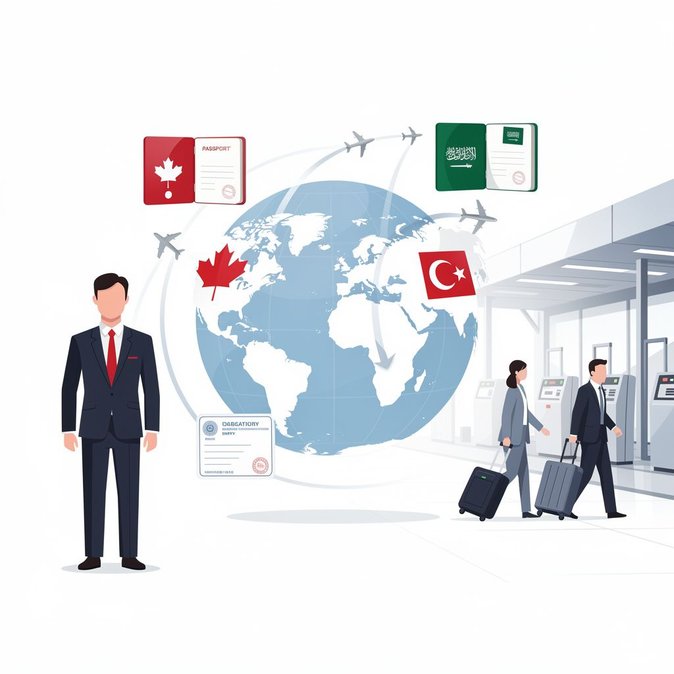
On June 30, Ottawa confirmed that Prime Minister Mark Carney will attend the NATO Summit in Ankara from July 6-8 before travelling to Saudi Arabia for the first bilateral visit by a Canadian leader in 26 years. The stated agenda focuses on defence and investment, but officials also flagged “tourism and infrastructure” as priority sectors—language that insiders interpret as groundwork for streamlined business-visitor rules and reciprocal trusted-traveller programmes.
For Canadian companies and frequent flyers who need to keep projects moving while the governments hammer out new arrangements, VisaHQ’s Canada portal (https://www.visahq.com/canada/) can take the legwork out of current visa applications by compiling real-time entry requirements, generating customised document checklists, and providing end-to-end filing support—an efficient bridge until any future trusted-traveller systems are in place.
Canada already operates security-pre-screening arrangements with the United States and recently opened its first rail pre-clearance facility in Vancouver. Federal sources say Ottawa is studying whether similar models could apply to high-growth Gulf markets as part of broader economic diversification. During the Riyadh leg, Carney is expected to discuss a possible memorandum of understanding on short-stay multiple-entry visas for Canadian and Saudi technology executives, mirroring the six-month visa-waiver arrangement Canada signed with the United Arab Emirates in 2024. Diplomats note that Canadian mining and cleantech firms eyeing Saudi giga-projects frequently cite visa processing times and local sponsorship requirements as deal-breakers. For global mobility and assignment managers, the trip is more than ceremonial. A senior policy advisor in Global Affairs Canada told the Canadian Chamber of Commerce that “mobility irritants” are at the top of industry wish-lists headed to Ankara and Riyadh. Any outcome that cuts red tape—or at least sets a timeline for negotiations—could lower deployment costs for companies bidding on Middle-East contracts. While concrete policy announcements may not surface until later this year, the mere inclusion of mobility language in the trip briefing signals that Ottawa sees people movement as integral to its Indo-Pacific and Middle-East engagement strategies.
For Canadian companies and frequent flyers who need to keep projects moving while the governments hammer out new arrangements, VisaHQ’s Canada portal (https://www.visahq.com/canada/) can take the legwork out of current visa applications by compiling real-time entry requirements, generating customised document checklists, and providing end-to-end filing support—an efficient bridge until any future trusted-traveller systems are in place.
Canada already operates security-pre-screening arrangements with the United States and recently opened its first rail pre-clearance facility in Vancouver. Federal sources say Ottawa is studying whether similar models could apply to high-growth Gulf markets as part of broader economic diversification. During the Riyadh leg, Carney is expected to discuss a possible memorandum of understanding on short-stay multiple-entry visas for Canadian and Saudi technology executives, mirroring the six-month visa-waiver arrangement Canada signed with the United Arab Emirates in 2024. Diplomats note that Canadian mining and cleantech firms eyeing Saudi giga-projects frequently cite visa processing times and local sponsorship requirements as deal-breakers. For global mobility and assignment managers, the trip is more than ceremonial. A senior policy advisor in Global Affairs Canada told the Canadian Chamber of Commerce that “mobility irritants” are at the top of industry wish-lists headed to Ankara and Riyadh. Any outcome that cuts red tape—or at least sets a timeline for negotiations—could lower deployment costs for companies bidding on Middle-East contracts. While concrete policy announcements may not surface until later this year, the mere inclusion of mobility language in the trip briefing signals that Ottawa sees people movement as integral to its Indo-Pacific and Middle-East engagement strategies.