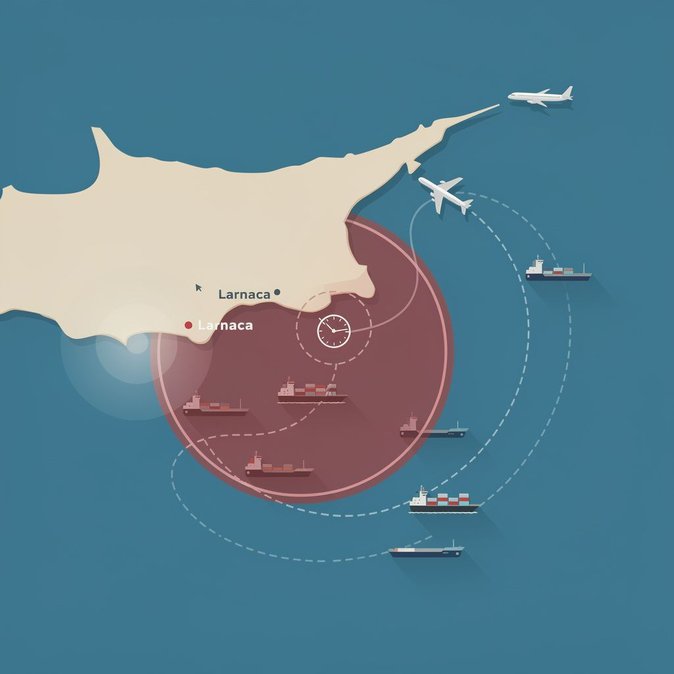
The Joint Rescue Coordination Centre (JRCC) in Larnaca activated NAVWARN 193/26 early on 30 June 2026, advising mariners that the Cyprus Navy would conduct gunnery exercises between 05:00 and 09:00 UTC. The temporary danger area—bounded by four coordinates roughly 20 km south-west of Cape Kiti—covers part of a busy approach route to Larnaca and Limassol ports.
For seafarers, tourists, and crew who may find themselves needing rapid entry clearance to Cyprus in light of such operational changes, VisaHQ can expedite Cyprus visa processing and provide real-time entry guidance. Their online platform—https://www.visahq.com/cyprus/—offers straightforward applications and status tracking, minimizing administrative delays for those whose itineraries are affected by short-notice NAVWARNs or schedule shifts.
While live-fire notices are routine for naval forces, today’s window coincides with peak summer cruise and charter-yacht movements. Hermes Airports confirmed that three inbound flights from Tel Aviv and Athens were instructed to adopt slightly longer coastal go-arounds to ensure de-confliction with naval gunnery arcs, adding an average of six minutes’ flight time. Freight forwarders report minimal impact on container schedules—the major feeder services adjusted speed overnight to clear the exclusion box before first light. From a compliance perspective, companies operating vessels under time charter must file amended passage plans with their P&I insurers and port agents, or risk breaching the International Safety Management (ISM) Code. Crews on small pleasure craft that ignore the NAVWARN could face fines up to €10,000 under Cyprus’s 2024 Maritime Safety Act. Although the JRCC lifted the warning at 09:05 UTC without incident, logistics managers are reminded that Cyprus typically publishes gunnery schedules only 24 hours in advance. Firms moving high-value or temperature-sensitive goods through Limassol should therefore build at least a four-hour buffer into delivery timetables during the summer exercise season. Looking ahead, the Ministry of Defence plans a larger two-day joint drill with EU partners in mid-July; advance warnings will be posted on the JRCC portal and via SafetyNet broadcasts, reinforcing the need for real-time voyage monitoring tools in corporate travel policies.
For seafarers, tourists, and crew who may find themselves needing rapid entry clearance to Cyprus in light of such operational changes, VisaHQ can expedite Cyprus visa processing and provide real-time entry guidance. Their online platform—https://www.visahq.com/cyprus/—offers straightforward applications and status tracking, minimizing administrative delays for those whose itineraries are affected by short-notice NAVWARNs or schedule shifts.
While live-fire notices are routine for naval forces, today’s window coincides with peak summer cruise and charter-yacht movements. Hermes Airports confirmed that three inbound flights from Tel Aviv and Athens were instructed to adopt slightly longer coastal go-arounds to ensure de-confliction with naval gunnery arcs, adding an average of six minutes’ flight time. Freight forwarders report minimal impact on container schedules—the major feeder services adjusted speed overnight to clear the exclusion box before first light. From a compliance perspective, companies operating vessels under time charter must file amended passage plans with their P&I insurers and port agents, or risk breaching the International Safety Management (ISM) Code. Crews on small pleasure craft that ignore the NAVWARN could face fines up to €10,000 under Cyprus’s 2024 Maritime Safety Act. Although the JRCC lifted the warning at 09:05 UTC without incident, logistics managers are reminded that Cyprus typically publishes gunnery schedules only 24 hours in advance. Firms moving high-value or temperature-sensitive goods through Limassol should therefore build at least a four-hour buffer into delivery timetables during the summer exercise season. Looking ahead, the Ministry of Defence plans a larger two-day joint drill with EU partners in mid-July; advance warnings will be posted on the JRCC portal and via SafetyNet broadcasts, reinforcing the need for real-time voyage monitoring tools in corporate travel policies.