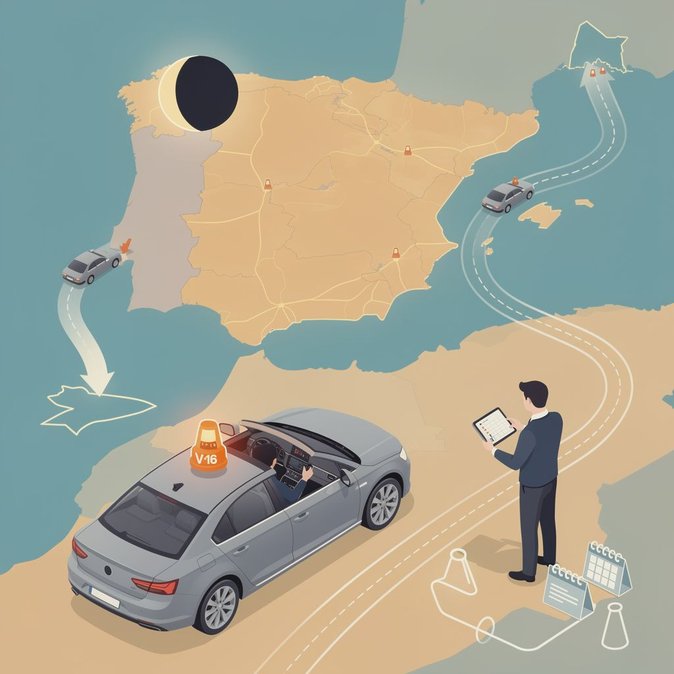
The Directorate-General of Traffic (DGT) activated its ‘Operación Verano 2026’ on 30 June, unveiling a four-phase plan to manage an expected 104 million long-distance road trips between July and September. The operation dovetails with special arrangements for the Paso del Estrecho and Paso de Portugal cross-border movements, together with an extraordinary deployment for the 12 August solar eclipse that will sweep parts of northern Spain. From 3–5 July alone, the first phase anticipates 4.83 million road journeys. Measures include 780 fixed speed-cameras, 545 mobile units, 15 drones and 39 camouflaged vans, plus dynamic lane reversals on key exit motorways from Madrid, Barcelona, Valencia and Seville.
Travellers who discover that their itineraries now involve unexpected landings or layovers in Spain can quickly verify and obtain any required visas through VisaHQ. The platform’s dedicated Spain page (https://www.visahq.com/spain/) offers step-by-step guidance, online applications and real-time tracking, helping drivers and passengers align their documentation with the DGT’s broader push for smoother summer mobility.
The DGT will also coordinate with port authorities in Algeciras, Tarifa and Almería to smooth vehicle flows for Maghrebi expatriates driving to Morocco. For international assignees and corporate fleets the plan means tighter enforcement of speed and alcohol limits, rolling lane closures and potential congestion at border ports. Mobility managers should brief drivers, allow extra time for airport and ferry transfers, and monitor DGT real-time traffic feeds. Companies operating shuttle services for holiday staff rotations should also note that certain heavy-goods restrictions will be lifted outside peak hours to maintain supply-chain continuity. Interior Minister Fernando Grande-Marlaska highlighted a 5 % year-on-year drop in summer road fatalities since digital traffic-management tools were expanded last year, urging travellers to “combine patience with planning” as biometric passport checks and high road volumes converge.

Travellers who discover that their itineraries now involve unexpected landings or layovers in Spain can quickly verify and obtain any required visas through VisaHQ. The platform’s dedicated Spain page (https://www.visahq.com/spain/) offers step-by-step guidance, online applications and real-time tracking, helping drivers and passengers align their documentation with the DGT’s broader push for smoother summer mobility.
The DGT will also coordinate with port authorities in Algeciras, Tarifa and Almería to smooth vehicle flows for Maghrebi expatriates driving to Morocco. For international assignees and corporate fleets the plan means tighter enforcement of speed and alcohol limits, rolling lane closures and potential congestion at border ports. Mobility managers should brief drivers, allow extra time for airport and ferry transfers, and monitor DGT real-time traffic feeds. Companies operating shuttle services for holiday staff rotations should also note that certain heavy-goods restrictions will be lifted outside peak hours to maintain supply-chain continuity. Interior Minister Fernando Grande-Marlaska highlighted a 5 % year-on-year drop in summer road fatalities since digital traffic-management tools were expanded last year, urging travellers to “combine patience with planning” as biometric passport checks and high road volumes converge.