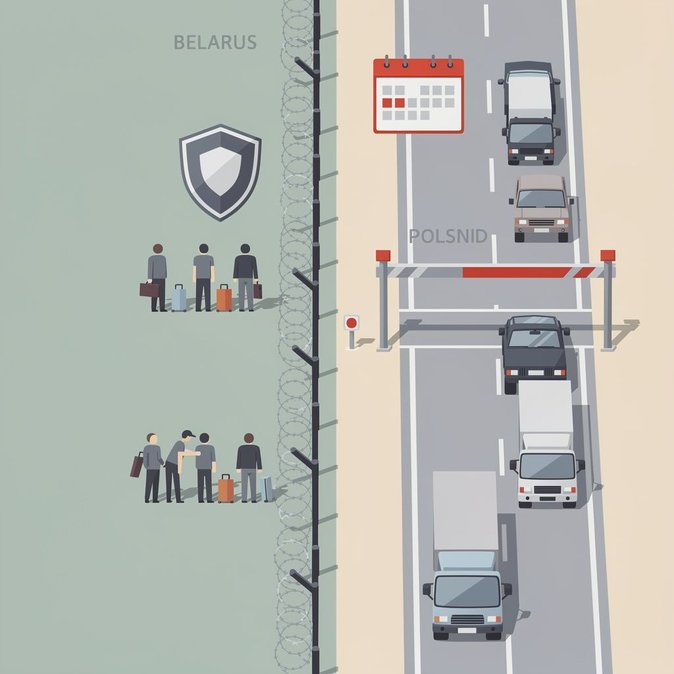
The Polish Council of Ministers has once again extended the exceptional regulation that suspends the right to file an asylum application at border posts along the 418-kilometre frontier with Belarus. The new ordinance, published in the Journal of Laws on 30 June, rolls the measure forward by another 60 days – this time until 20 July 2026 – citing "continued instrumentalisation of migration" by Minsk and ongoing hybrid attacks against Polish officers. This is the seventh rollover since the mechanism debuted in March 2025.
Amid this shifting regulatory environment, VisaHQ’s Poland desk can assist corporations and individual travellers in navigating the evolving entry rules. Their online platform (https://www.visahq.com/poland/) offers up-to-date guidance on Polish visas, humanitarian exemptions and transit documentation, helping applicants assemble the correct paperwork before arriving at designated checkpoints.
According to the Ministry of the Interior, the policy has reduced attempted irregular crossings and “brought the monthly number of successful entries down to zero” in Q1 2026. Statistics quoted in the explanatory note show that from 27 March 2025 to 26 May 2026 border guards refused to accept 480 applications while processing 141 from vulnerable groups allowed an exemption. Human-rights NGOs argue the measure violates Article 56 of Poland’s Constitution and the 1951 Geneva Convention, warning that refugees are pushed back without due process. Several organisations are preparing to challenge the extension before Poland’s Supreme Administrative Court and the Strasbourg-based European Court of Human Rights. For multinational employers the continuation means staff transiting via Belarus or arriving from the East may face stricter checks and longer waiting times at the Terespol rail checkpoint and the Kuznica and Bobrowniki road crossings, the only points where limited commercial traffic is currently processed. Companies relocating non-EU talent should route newcomers through Warsaw Chopin or Rzeszów Jasionka airports instead, and verify that humanitarian-visa holders carry proof of exemption before travel.
Amid this shifting regulatory environment, VisaHQ’s Poland desk can assist corporations and individual travellers in navigating the evolving entry rules. Their online platform (https://www.visahq.com/poland/) offers up-to-date guidance on Polish visas, humanitarian exemptions and transit documentation, helping applicants assemble the correct paperwork before arriving at designated checkpoints.
According to the Ministry of the Interior, the policy has reduced attempted irregular crossings and “brought the monthly number of successful entries down to zero” in Q1 2026. Statistics quoted in the explanatory note show that from 27 March 2025 to 26 May 2026 border guards refused to accept 480 applications while processing 141 from vulnerable groups allowed an exemption. Human-rights NGOs argue the measure violates Article 56 of Poland’s Constitution and the 1951 Geneva Convention, warning that refugees are pushed back without due process. Several organisations are preparing to challenge the extension before Poland’s Supreme Administrative Court and the Strasbourg-based European Court of Human Rights. For multinational employers the continuation means staff transiting via Belarus or arriving from the East may face stricter checks and longer waiting times at the Terespol rail checkpoint and the Kuznica and Bobrowniki road crossings, the only points where limited commercial traffic is currently processed. Companies relocating non-EU talent should route newcomers through Warsaw Chopin or Rzeszów Jasionka airports instead, and verify that humanitarian-visa holders carry proof of exemption before travel.