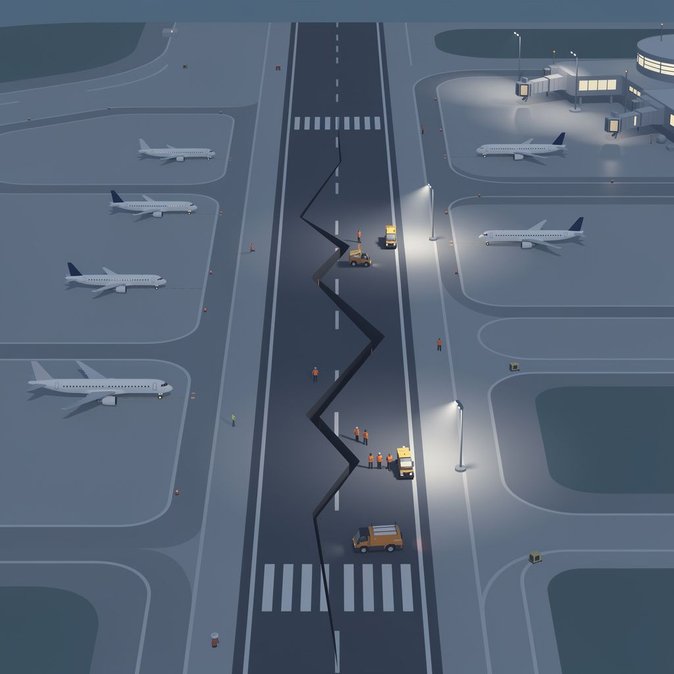
Warsaw’s Chopin Airport – Poland’s busiest international gateway – was forced to take one of its two runways out of service early on 30 June after routine morning inspections revealed a series of small surface cracks. Airport spokesman Piotr Rudzki told reporters that the decision was taken “out of an abundance of caution” because even minor irregularities on a runway can cause rubber-burn damage to aircraft tyres and increase the risk of foreign-object debris being ingested by engines. Engineers moved quickly to seal the fissures with a fast-curing resin, but the material needs several hours to harden. With holiday traffic already peaking at close to 900 flight movements a day, operations were consolidated onto the secondary runway, reducing hourly capacity by roughly 35 %. LOT, Wizz Air and other carriers warned passengers to expect delays of up to 45 minutes, particularly on narrow-body European rotations scheduled during the midday rush. The incident highlights the mounting infrastructure pressures at Chopin, which handled a record 24 million passengers in 2025 – well above its design capacity of 22 million. A long-planned Central Polish Airport near Łódź is intended to relieve Warsaw but will not open until 2032, meaning that runway maintenance windows at Chopin will remain a delicate balancing act for the next several summers. For corporate mobility managers the key takeaway is that contingency buffers should be built into itineraries involving Warsaw this summer, especially for same-day connections. Travellers with tight onward links in Frankfurt, Paris or London may wish to book earlier flights or consider the capital’s smaller Modlin Airport for low-cost options. Cargo shippers moving high-value or perishable goods ought likewise to monitor NOTAMs and airline advisories, as ad-hoc slot restrictions can reverberate through belly-hold capacity. Airport authorities say the affected runway should reopen overnight once repairs have cured, but a full structural survey is being commissioned to determine whether deeper resurfacing will be required during the autumn shoulder season.
Source: Rzeczpospolita